
Fire leaves behind more than charred wood and ash. Even after the flames are out, the damage keeps spreading, smoke odor seeps into wall cavities, soot settles into HVAC ductwork, and acidic residue starts corroding metal surfaces within hours. Understanding the fire damage restoration process helps you know what to expect, ask the right questions, and avoid decisions that could make recovery harder or more expensive.
What Happens to a Home After a Fire (It’s More Than You Can See)
The visible burn zone is usually the smallest part of the problem. Smoke travels fast and far, it follows air currents, slips through wall penetrations, and deposits a thin, oily film on surfaces in rooms that never saw a flame. That film, called soot, is mildly acidic. On metal fixtures, it begins pitting within 24 to 48 hours. On porous surfaces like drywall and wood trim, it bonds quickly, making it harder to remove the longer it sits.
Smoke also carries volatile organic compounds (VOCs) that off-gas long after the fire is out. That’s why a house can smell like smoke weeks later even after a surface cleaning, the odor source is often inside wall cavities, insulation, or subflooring, not on the walls themselves.
Water damage is almost always part of the picture too. Firefighting efforts can leave standing water, saturated insulation, and wet structural materials that need to be dried before restoration can begin. In a North Carolina summer, that moisture becomes a mold risk within 24 to 72 hours.
The Restoration Process, Step by Step
Professional fire damage restoration follows a structured sequence. Skipping steps, or doing them out of order, tends to trap odors, hide moisture, or create problems that resurface months later.
1. Emergency stabilization and safety assessment
Before any cleanup begins, the structure needs to be assessed for safety. This means checking for compromised load-bearing elements, broken gas lines, and live electrical hazards. Utilities may need to be shut off. Openings in the roof or walls get boarded or tarped to prevent weather intrusion and further loss, this is called emergency board-up, and it also helps protect the property from theft while it’s unoccupied.
2. Documentation for your insurance claim
A thorough photo and written record of all damage is created before anything is moved or removed. This documentation is the foundation of your insurance claim. Restoration companies that work regularly with insurance carriers know what adjusters need to see, room-by-room photos, moisture readings, and itemized scope of damage.
3. Water extraction and structural drying
If firefighting water is present, it comes out first. Industrial extractors pull standing water from flooring, and high-capacity air movers and dehumidifiers are set up to dry structural materials. Moisture meters track progress in walls, subfloors, and framing. This phase can take several days depending on how much water was used and how the building is constructed.
4. Soot and smoke residue removal
This is where fire restoration diverges sharply from a standard cleaning job. Different surfaces require different cleaning methods, dry chemical sponges for flat soot on painted walls, wet cleaning for greasy protein residues (common after kitchen fires), and HEPA vacuuming for loose ash. The wrong method can push soot deeper into a surface or spread it to areas that weren’t affected. Porous materials like upholstered furniture, carpet, and insulation often can’t be cleaned to an acceptable standard and need to be removed.
HVAC systems get special attention. Smoke circulates through ductwork during and after a fire, and a system that isn’t cleaned will redistribute odor and particulates every time it runs.
5. Odor elimination
Surface cleaning alone rarely eliminates smoke odor. Professional odor treatment uses a combination of thermal fogging, hydroxyl generators, or ozone treatment to neutralize odor molecules in the air and inside porous materials. The method depends on the type of fire, the materials involved, and whether occupants or pets need to be present. This step is often what separates a home that smells clean from one that still carries a faint smoke smell years later.
6. Structural repairs and reconstruction
Once the structure is clean, dry, and deodorized, repairs begin. This ranges from replacing drywall and insulation to full framing repairs in heavily burned areas. In some cases, the same restoration company handles both the mitigation and the rebuild, which simplifies the insurance process and keeps the project on a single timeline.
What Not to Do After a Fire
A few common mistakes can complicate recovery significantly:
- Don’t run your HVAC system. It will pull soot and smoke particles through the ductwork and deposit them in rooms that were unaffected.
- Don’t wipe soot with a wet cloth. Wet cleaning smears oily soot into the surface and makes it much harder to remove. Dry chemical sponges come first.
- Don’t throw away damaged items before documentation. Your insurance adjuster and the restoration team need to see what was lost. Photograph everything before anything is discarded.
- Don’t assume a room is fine because it didn’t burn. Smoke travels. A bedroom two floors above a basement fire can have measurable soot and odor contamination.
- Don’t use scented sprays or candles to mask the smell. They don’t neutralize odor compounds, they layer over them temporarily and can make professional odor treatment more complicated.
When to Call a Professional
For any fire that required a call to the fire department, professional restoration is the right call, not because the damage is necessarily catastrophic, but because the hidden damage (smoke in the walls, moisture in the structure, soot in the ductwork) requires equipment and training that go beyond what a homeowner can do safely or effectively.
For very small, contained fires, a stovetop flare-up that was put out quickly with no structural damage, you may be able to handle cleanup yourself. But if there’s any visible soot on walls or ceilings beyond the immediate area, any smoke smell in adjacent rooms, or any water from extinguishing the fire, a professional assessment is worth the call. Many restoration companies will do an initial walkthrough at no charge.
North Carolina’s climate adds a layer of urgency. The combination of warm temperatures and high humidity, especially in the eastern part of the state, means that any moisture left behind from firefighting efforts can become a mold problem faster than it would in a drier climate. Timing matters.
The Longer Recovery: What to Expect Over Weeks and Months
Fire restoration isn’t a one-day job. A moderate house fire typically involves one to two weeks of mitigation work (drying, cleaning, odor treatment) followed by weeks or months of reconstruction depending on the scope of damage. During that time, you may be living elsewhere, coordinating with your insurance adjuster, and making decisions about materials and finishes.
Keep a written log of every conversation with your insurer and every decision made on-site. Ask for a written scope of work before restoration begins, and make sure you understand what’s included. Reputable restoration contractors provide itemized documentation throughout the process, both for your records and to support your claim.
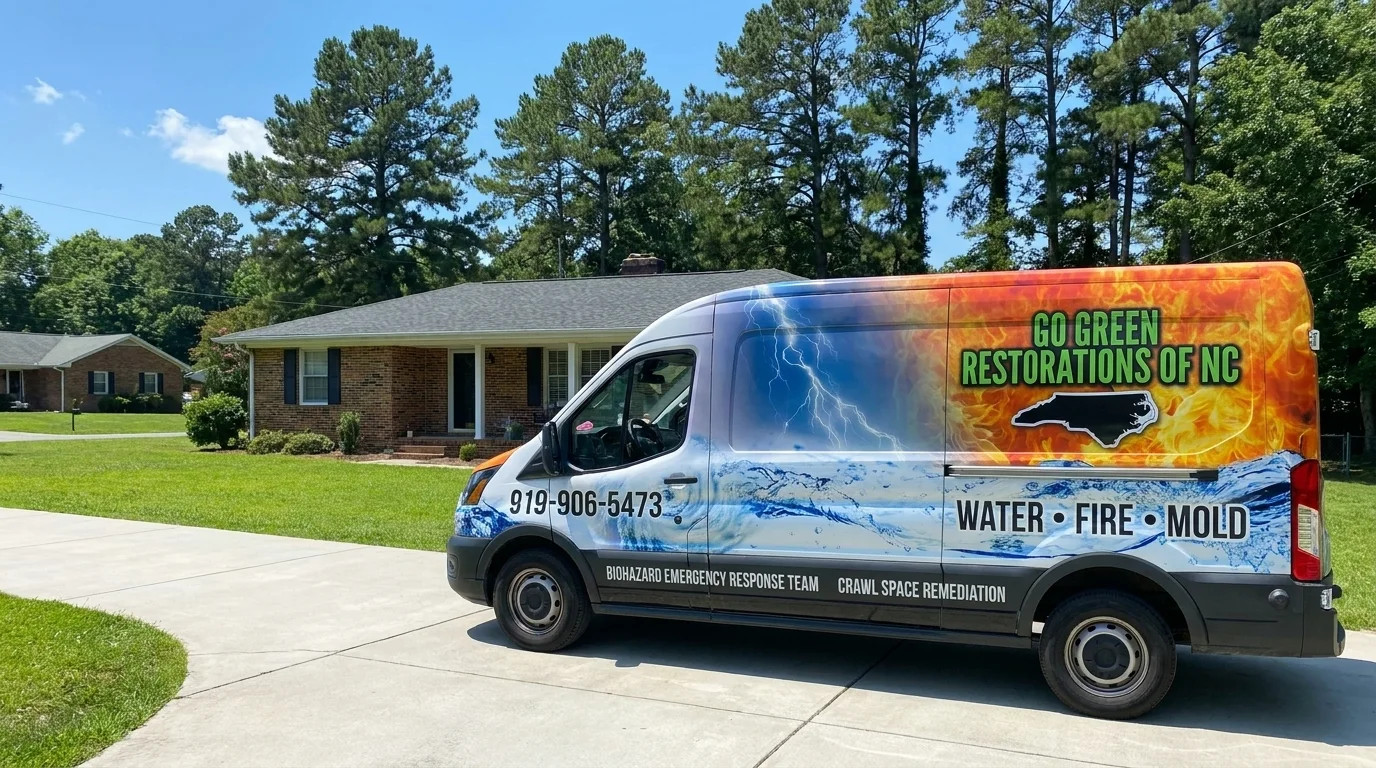
If you’re dealing with fire or smoke damage in the Middlesex area and aren’t sure where to start, Go Green Restoration of NC handles both the mitigation side, soot removal, odor treatment, structural drying, and the reconstruction work that follows. Reach out at (919) 906-5473 to talk through what you’re seeing and what the next steps look like for your specific situation.