
Air Duct Cleaning in Middlesex
24/7 air duct cleaning in Middlesex and surrounding areas. Insurance billing accepted. Call (919) 906-5473.
Every time your HVAC system kicks on, it pushes air through ductwork that may not have been cleaned in years, or ever. That air carries whatever has accumulated inside: layers of dust and debris, pet dander, pollen, mold spores from a long-forgotten moisture event, and in older North Carolina homes, the fine particulate left behind by decades of combustion heating. If you’ve noticed a musty smell when the heat comes on, or visible dust puffing from registers the moment the system starts, the ducts themselves are the source, not the filter, not the blower.
What Air Duct Cleaning actually involves
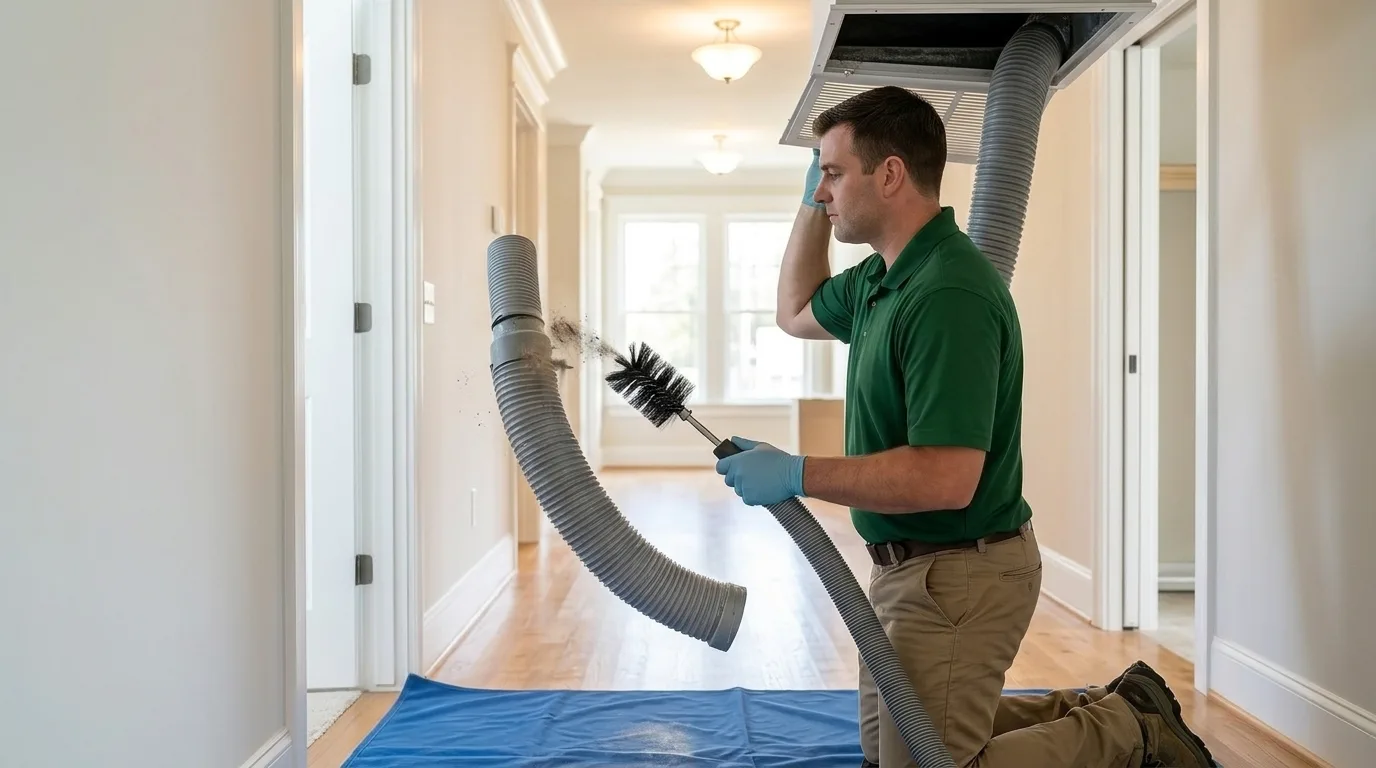
Air duct cleaning is not vacuuming the register covers. A proper HVAC duct cleaning job requires negative-pressure equipment, typically a truck-mounted or portable vacuum collection unit capable of generating 4,000 to 8,000 CFM of airflow, connected directly to the main supply and return trunk lines. That negative pressure turns the duct system into a sealed chamber. Technicians then work section by section, using rotary brush agitation tools and compressed-air whips to dislodge debris from duct walls, driving it toward the collection unit rather than back into the living space.
A full residential duct cleaning on a typical central-NC home, single-story slab, two-ton system, eight to twelve supply registers, takes three to five hours. Larger two-story homes or systems with flex duct runs that have partially collapsed (common in attics after hot Middlesex summers) take longer, because those sections need to be identified and either corrected or flagged before cleaning proceeds. Dryer vent cleaning is often bundled at the same visit: lint accumulation in the exhaust line is a leading cause of house fires, and the access is already staged.
When microbial growth is present, visible mold on duct liner, or confirmed by an air quality test, air duct sanitization follows the mechanical cleaning. An EPA-registered antimicrobial fog is applied to interior duct surfaces after debris removal, not before. Applying sanitizer to fouled ducts is a common shortcut that doesn’t work.
Our process
-
System inspection and pre-cleaning assessment. Before any equipment is connected, technicians photograph register conditions, check for visible mold or pest intrusion at accessible points, and assess whether any flex duct sections are crushed or disconnected, a problem that makes cleaning ineffective and needs to be corrected first.
-
Negative-pressure containment setup. The collection unit is connected to the main trunk line. All supply registers are sealed with cover plates so the system draws from a single controlled point. This step is what separates a legitimate duct cleaning from a blow-and-go operation.
-
Mechanical agitation, zone by zone. Starting farthest from the collection point, technicians work each branch run with rotary brushes and compressed-air tools, loosening debris and driving it toward the vacuum. Supply and return sides are cleaned separately.
-
Dryer vent cleaning (if included). The dryer exhaust line is cleared with a rotary brush system from the exterior cap back to the machine connection. Technicians verify airflow at the cap before closing out.
-
Air duct sanitization and post-cleaning verification. If sanitization was scoped, the EPA-registered antimicrobial is applied now, to clean surfaces. Final photographs document register conditions and confirm debris removal. Any disconnected or damaged duct sections found during cleaning are noted in writing.
What separates a good duct cleaning from a bad one
The single biggest differentiator is negative pressure. Without a proper collection unit creating suction at the trunk, agitation tools simply redistribute debris inside the duct system, some of it ends up back in the living space. This is why post-cleaning air quality can actually test worse after a low-quality duct cleaning than before.
A second common failure is skipping the return side. Supply ducts get cleaned; return ducts, which pull air back to the air handler, are often ignored because they’re harder to access. Dirty return ducts mean the system is continuously pulling contaminated air across the coil.
For insurance-related losses (a mold event, a fire where smoke entered the duct system, or a flood where standing water reached the air handler), documentation matters. Adjusters want pre- and post-cleaning photographs, a written scope identifying which components were cleaned versus replaced, and confirmation that any sanitization product used is EPA-registered. Cutting corners on paperwork creates claim disputes later.
What does Air Duct Cleaning cost?
Typical costs vary based on system size, duct material, degree of contamination, and whether sanitization or dryer vent cleaning is included. Most homeowners pay somewhere in the ranges below, these are industry-typical figures, not a quote from Go Green Restoration of NC.
| Scenario | Typical range |
|---|---|
| Small home, 1 system, light dust accumulation | $300 – $500 |
| Average home (1,500–2,500 sq ft), 1 system | $450 – $750 |
| Large home or 2 systems | $700 – $1,200 |
| Dryer vent cleaning (standalone) | $100 – $175 |
| Air duct sanitization added to cleaning | $150 – $350 additional |
| Post-water-damage or post-fire duct restoration | $800 – $2,500+ |
Every loss is different, and Go Green Restoration of NC provides a written scope before any work begins. Standard homeowners insurance typically does not cover routine duct cleaning, but it often does cover duct cleaning and sanitization when the contamination is the direct result of a covered peril, a burst pipe that flooded the air handler, smoke from a covered fire, or mold growth caused by a sudden water loss.
Seasonal and regional considerations
Middlesex and the surrounding Johnston, Nash, and Wake County corridor runs humid from April through October. That humidity matters for ducts: fiberglass duct liner absorbs moisture, and any system that has experienced a condensation issue, a coil leak, or a crawlspace flood is at elevated risk for mold colonization inside the ductwork. Mold can begin colonizing damp organic material within 24 to 48 hours, which means a slow coil drain pan leak that goes unnoticed for a season can result in significant interior duct contamination by the time it’s discovered.
Winter in central NC brings its own issue: when homes are closed up and heating systems run continuously, airborne particulate concentrations rise. Fall, before heating season starts, is the most practical time for a cleaning, but post-event cleaning (after a water loss, fire, or renovation) should happen as soon as the primary damage work is complete.
Service area
Go Green Restoration of NC is based in Middlesex, NC and serves surrounding communities including Zebulon, Wendell, Knightdale, Rocky Mount, Wilson, and the greater Raleigh metro. The city-specific service pages for each of those areas link back here for detailed process and technical information.
If you’re noticing dust at your registers, a musty odor when the system runs, or you’ve recently dealt with a water or fire loss that may have reached your ductwork, call Go Green Restoration of NC at (919) 906-5473 to schedule your duct inspection and cleaning.
Services We Handle
- Air Duct & HVAC Cleaning
Frequently Asked Questions
How do I know if my ducts actually need cleaning, or if a company is just trying to upsell me?
What's the difference between duct cleaning and duct sanitization — do I need both?
Does homeowners insurance cover air duct cleaning?
Can duct cleaning make indoor air quality worse if it's done incorrectly?
How often should dryer vent cleaning be done, and what happens if it's neglected?
Looking for the best air duct cleaning company in Middlesex?
Go Green Restoration of NC provides air duct cleaning in Middlesex, NC and the surrounding area. We answer calls 24/7 — call (919) 906-5473 for immediate help.
Need Air Duct Cleaning now?
We respond 24/7 across Middlesex and surrounding NC cities.