
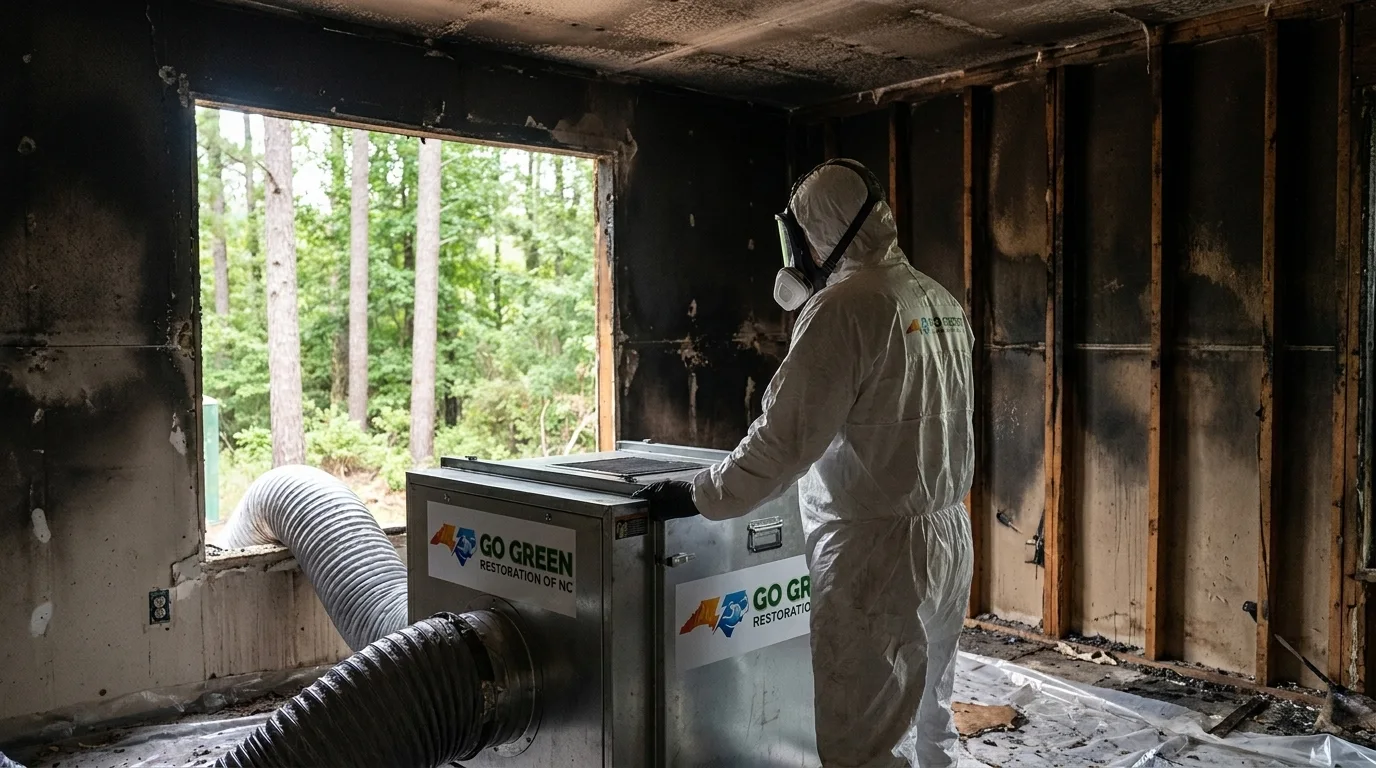
Fire Damage Restoration in Middlesex
24/7 fire damage restoration in Middlesex and surrounding areas. Insurance billing accepted. Call (919) 906-5473.
Smoke doesn’t stop at the burn line. After a house fire, soot travels through HVAC ducts, settles into closets two rooms away, and embeds in porous surfaces within hours. The smell you notice a week later, that sharp, oily residue clinging to walls and fabric, is protein or synthetic soot continuing to off-gas and etch finishes. Fire damage restoration isn’t just cleaning what burned; it’s tracing everywhere combustion byproducts traveled and reversing the damage before it becomes permanent.
What fire damage restoration actually involves
The visible char is usually the smallest part of the problem. Soot particles, some as fine as 0.1 microns, coat surfaces, infiltrate wall cavities, and migrate through air pressure differentials created when a structure cools after a fire. Depending on what burned, you may be dealing with wet soot (from slow, smoldering combustion), dry soot (fast, high-temperature fires), or protein residue (from kitchen fires, nearly invisible but intensely pungent and notoriously difficult to remove from painted surfaces).
Beyond soot, fire damage restoration typically involves:
- Structural assessment, identifying compromised framing, subfloor, and load-bearing elements before any cleaning begins
- Contents evaluation and pack-out, determining what can be restored off-site versus what must be documented as a total loss
- Odor neutralization, thermal fogging and ozone treatment to break down odor molecules embedded in materials that surface cleaning cannot reach
- Water damage mitigation, suppression water from firefighting sits in walls and under flooring and must be extracted and dried before reconstruction begins
Timelines vary with the size and intensity of the fire. A contained kitchen fire may resolve in days; a fire that reached the attic or spread through multiple rooms typically requires weeks of coordinated mitigation, contents handling, and reconstruction.
Our process
1. Emergency stabilization and safety assessment Before any cleaning equipment enters the structure, the building is evaluated for structural integrity, active utility hazards, and air quality. Utilities may need to be isolated. Areas with compromised framing or roofing are documented and secured against weather intrusion, a tarp on an open roof in the first 24 hours prevents a secondary water loss that can dwarf the original fire damage.
2. Soot characterization and containment Not all soot responds to the same cleaning chemistry. Dry soot brushes off porous surfaces but smears if wiped with the wrong technique. Protein soot requires enzymatic or alkaline cleaners and multiple passes. Synthetic soot from burning plastics and foam contains compounds that can permanently stain if treated incorrectly. Affected zones are contained to prevent cross-contamination to unaffected areas during cleaning.
3. Structural and surface cleaning Ceilings first, then walls, then floors, always working top-down so dislodged residue doesn’t re-contaminate cleaned surfaces. HEPA-filtered vacuums remove loose soot before any wet cleaning begins. Ductwork is cleaned or sealed to prevent redistributing soot through the HVAC system when heat or air conditioning is restored.
4. Thermal fogging and ozone treatment Surface cleaning removes visible soot but rarely eliminates odor entirely. Thermal fogging disperses a deodorizing agent in particle sizes that mimic smoke, reaching the same cavities and porous materials the smoke penetrated. Ozone treatment, applied only after occupants and pets have vacated, oxidizes odor molecules at the molecular level. These steps are sequenced, not interchangeable.
5. Reconstruction scope and rebuild Once the structure is clean, dry, and odor-free, a written reconstruction scope documents every material to be replaced, drywall, insulation, flooring, cabinetry, trim, with line-item detail that supports the insurance claim. Reconstruction proceeds from framing outward, with inspections at each stage.
What separates a good fire damage response from a bad one
The most common mistake is starting reconstruction before the structure is fully dry. Suppression water trapped behind freshly installed drywall creates the conditions for mold colonization within days. A thorough moisture survey, using thermal imaging and pin-type meters in wall cavities, not just surface readings, is non-negotiable before any rebuild begins.
A second frequent failure is incomplete soot mapping. Smoke follows air currents, and in a forced-air home, those currents reach every room with a supply or return vent. Limiting cleaning to the “fire room” and adjacent spaces routinely leaves protein or synthetic soot in bedrooms and closets that resurfaces as odor months later.
Insurance adjusters look for itemized documentation: photographs of affected materials before removal, moisture readings with timestamps and meter calibration records, and a contents inventory that distinguishes restorable items from total losses. Thorough documentation protects the homeowner’s claim and avoids disputes over scope during the settlement process.
What does fire damage restoration cost?
Typical costs depend heavily on fire intensity, affected square footage, the materials involved, and whether the HVAC system distributed soot throughout the structure. Most homeowners pay somewhere in the ranges below, these are industry-typical figures, not quotes from Go Green Restoration of NC.
| Scenario | Typical range |
|---|---|
| Contained kitchen fire, single room | $3,000 – $8,000 |
| Multi-room soot and smoke damage, no structural loss | $8,000 – $20,000 |
| Partial structural fire with framing damage | $20,000 – $60,000 |
| Whole-home fire with roof or floor system involvement | $60,000 – $150,000+ |
| Contents pack-out and off-site cleaning | $2,000 – $10,000 |
| Ductwork cleaning and sealing | $500 – $2,500 |
Every loss is different, Go Green Restoration of NC provides a written scope of work before any billable work begins. Homeowners insurance typically covers fire damage restoration including soot cleanup, odor treatment, contents handling, and reconstruction, subject to your deductible and policy limits.
Seasonal and regional considerations
In central North Carolina, the combination of older housing stock and wood-framed construction common in Johnston, Nash, and Wake counties means fire can move quickly through balloon-framed walls with limited fire-stopping. Homes built before the 1980s may also have knob-and-tube wiring or older HVAC configurations that complicate both the fire’s spread and the restoration scope. Humidity levels across the region, particularly from late spring through early fall, accelerate mold risk when suppression water is not extracted promptly, making the first 48 hours after a fire critical even when the fire itself was small.
Service area
Go Green Restoration of NC is based in Middlesex, NC and serves surrounding communities throughout the region, including Zebulon, Wendell, Wilson, Rocky Mount, Nashville, Kenly, and Selma. Individual city pages detail local response logistics, this page covers the full scope of what fire damage restoration involves regardless of location.
If you’re looking at smoke-stained walls right now, the next step is a damage assessment, not a guess at what it will cost. Call Go Green Restoration of NC at (919) 906-5473 to begin smoke and soot removal and get a written scope before any work starts.
Frequently Asked Questions
What's the difference between protein soot and synthetic soot, and why does it change how cleanup works?
Does homeowners insurance cover fire damage restoration?
Why does my house still smell like smoke weeks after the fire was put out?
How does suppression water from firefighting affect the restoration process?
Can smoke-damaged contents be restored, or does everything need to be replaced?
Looking for the best fire damage restoration company in Middlesex?
Go Green Restoration of NC provides fire damage restoration in Middlesex, NC and the surrounding area. We answer calls 24/7 — call (919) 906-5473 for immediate help.
Need Fire Damage Restoration now?
We respond 24/7 across Middlesex and surrounding NC cities.
Related Coverage
- Our Restoration Services
- Contact Go Green Restoration of NC
- Fire Damage Restoration in Durham
- Fire Damage Restoration in Raleigh
- Fire Damage Restoration in Rocky Mount
- Fire Damage Restoration in Smithfield
- Fire Damage Restoration in Wake Forest
- Fire Damage Restoration in Wilson
- Fire Damage Restoration in Zebulon
- How To Choose a Restoration Company in (Without Getting Burned)
- The Fire Damage Restoration Process, Explained