
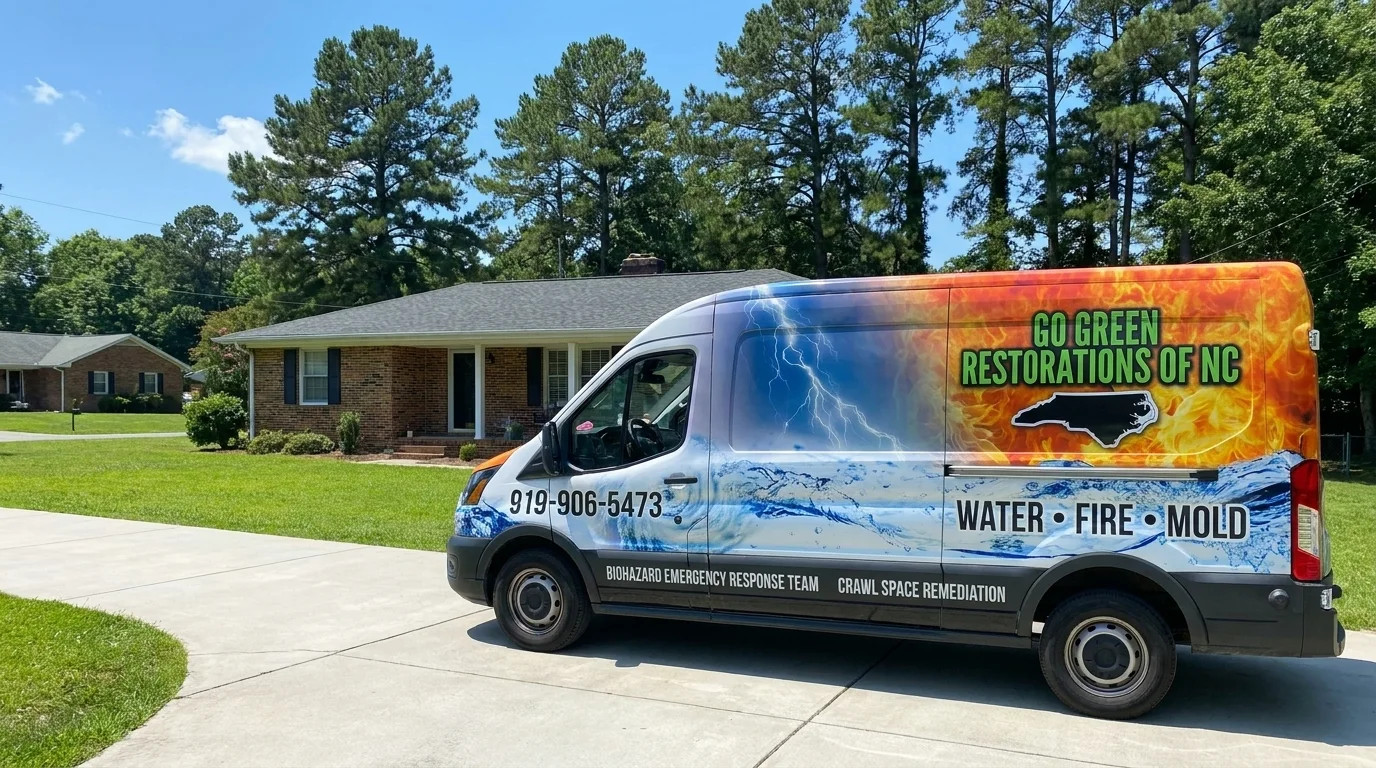
TL;DR: Water damage restoration in North Carolina typically costs $1,500 to $8,000 for most residential losses. Small, clean-water incidents (a burst supply line caught quickly) run $1,200 to $3,500. Large losses involving contaminated water, finished basements, or structural materials can reach $10,000 to $20,000 or more. Every loss is different, and Go Green Restoration of NC provides a written scope before any work begins.
If you just found water in your home and you’re trying to figure out what this is going to cost before you call your insurance company, this guide gives you real numbers. The ranges below reflect typical industry pricing for NC losses, not a quote. What you actually pay depends on four things: how much water, what kind of water, what it touched, and how fast you acted.
How Much Does Water Damage Restoration Cost in NC?
Most NC homeowners pay between $1,500 and $8,000 for water damage restoration, with the national average hovering around $3,500 for a mid-size residential loss. Smaller incidents on the low end, large multi-room or contaminated-water losses on the high end.
Here’s a scenario-by-scenario breakdown of typical ranges:
| Scenario | Typical Cost Range |
|---|---|
| Single room, clean water (Cat 1), caught within 24 hours | $1,200 - $3,500 |
| Two to three rooms, clean water, standard drywall and flooring | $3,500 - $6,500 |
| Finished basement flood, clean to gray water | $5,000 - $12,000 |
| Crawl space water intrusion, wood framing affected | $3,000 - $8,000 |
| Gray water loss (Cat 2) - washing machine, dishwasher overflow | $2,500 - $7,000 |
| Black water loss (Cat 3) - sewage backup or floodwater | $7,000 - $20,000+ |
| Whole-house event (roof failure, major pipe burst) | $15,000 - $40,000+ |
These are industry-typical ranges for the NC market. Your actual cost depends on the factors below.
What Factors Drive the Final Price?
Five variables move the number more than anything else.
Water category. The IICRC S500 standard classifies water losses into three categories. Category 1 is clean water from a supply line or appliance inlet. Category 2 (gray water) is mildly contaminated water from appliances like washing machines or dishwashers. Category 3 (black water) is grossly contaminated water: sewage backups, floodwater, or any water that has sat long enough to become biologically hazardous. Cat 3 losses require full PPE, antimicrobial treatment, and often complete removal of affected porous materials. They cost significantly more than Cat 1 losses of the same square footage.
Class of loss (how much moisture got absorbed). The IICRC also defines four classes based on evaporation load. A Class 1 loss (minimal absorption, hard surfaces only) dries fast. A Class 4 loss (deep into hardwood, concrete, or structural framing) requires specialty drying equipment and more time. More drying time means more equipment rental days and more labor.
Square footage affected. Restoration companies price by the affected area, not the whole house. A 200-square-foot bathroom loss costs far less than a 1,200-square-foot finished basement.
Materials involved. Drywall, insulation, hardwood flooring, cabinetry, and structural framing each have different removal and replacement costs. A loss that only touches tile and concrete dries cheaper than one that saturates laminate flooring and the subfloor beneath it. In older homes around the Nash and Johnston County line, crawl space framing and insulation are common casualties.
Response time. Water that sits more than 24 to 48 hours begins to grow mold, and materials that could have been dried in place now need to be removed. The EPA recommends beginning drying within 24 to 48 hours to prevent mold growth. A fast response almost always costs less than a delayed one.
What Does the Restoration Process Actually Include?
Water damage restoration is not just drying. Here is what a professional job covers, step by step.
1. Emergency extraction. The crew arrives, assesses the loss, and removes standing water using truck-mounted or portable extractors. For a flooded crawl space or basement, this can take several hours.
2. Moisture mapping. Technicians use thermal imaging cameras and calibrated moisture meters to map exactly where water traveled inside walls, floors, and ceilings. This step defines the scope of work and is critical for insurance documentation.
3. Controlled demolition (when needed). Saturated drywall, insulation, and flooring that cannot be dried in place are removed. This is called a “flood cut” when it involves cutting drywall at a set height above the waterline. Removing wet material is faster and cheaper than trying to dry it in place when absorption is deep.
4. Structural drying. Industrial air movers and LGR (low-grain refrigerant) dehumidifiers run continuously, often for three to five days. Technicians monitor moisture readings daily and adjust equipment placement. The goal is to return structural materials to their pre-loss moisture content, verified by instrument readings, not guesswork.
5. Antimicrobial treatment. Any surface that contacted Category 2 or 3 water, or any area where drying took more than 48 hours, receives EPA-registered antimicrobial treatment to prevent mold colonization.
6. Final documentation. Drying logs, moisture readings, and photo documentation are compiled for the insurance claim. This paperwork protects the homeowner if the insurer questions the scope later.
7. Reconstruction. Once the structure is dry and cleared, drywall, flooring, insulation, and finishes are rebuilt. Reconstruction is often a separate line item from mitigation and may be handled by the same company or a separate contractor.
For a detailed look at the timeline, see How Long Does Water Damage Restoration Actually Take?
Will Homeowners Insurance Cover This in NC?
Most standard homeowners policies in North Carolina cover sudden, accidental water damage but exclude gradual leaks and flood damage from rising water.
Here is how the typical coverage breakdown works:
- Covered: Burst pipe, appliance supply line failure, HVAC overflow, sudden roof leak during a storm (the water intrusion, not the roof itself)
- Usually covered: Ice dam damage, accidental overflow from a tub or sink
- Typically excluded: Slow leaks that developed over weeks or months, groundwater seepage, sewer backup (unless you added a rider), and any flooding from an external water source
- Flood damage: Requires a separate flood insurance policy through the NFIP (National Flood Insurance Program). Standard homeowners policies do not cover it.
Your deductible applies before coverage kicks in. Most NC homeowners carry deductibles between $1,000 and $2,500. For a $4,000 loss, you would receive roughly $1,500 to $3,000 after the deductible, assuming the cause is covered.
Documentation is what protects your claim. A restoration company that provides daily moisture logs, moisture-mapped photos, and a written scope of work gives your adjuster the evidence they need to process the claim cleanly. Go Green Restoration of NC handles that documentation as part of every job.
For a deeper look at what policies typically pay, see Does Homeowners Insurance Cover Water Damage? A Plain-English Guide.
If the loss started with a burst pipe, the Burst Pipe Checklist: Step-by-Step Response walks through what to do in the first hour before the crew arrives.
What Should You Do Right Now?
If water is still present or you found damage in the last 24 hours, the clock matters. Every hour of additional saturation increases the scope and the cost.
Stop the source first if you haven’t. Then call a restoration company before you call your insurance company. The adjuster will want to see a scope of work, and a restoration company can help you document the loss correctly from the start. Do not start tearing out wet materials yourself unless you have a way to document moisture readings before and after, because unsupported demo can complicate your claim.
Go Green Restoration of NC responds 24/7 across Middlesex, the US-264 corridor, and surrounding Nash and Johnston County communities. Call (919) 906-5473 to schedule an assessment. Every job starts with a written scope before work begins.
About Go Green Restoration of NC
Go Green Restoration of NC is a 24/7 restoration company based in Middlesex, NC (27557), serving the Triangle, Nash County, Johnston County, and surrounding communities. Their crews handle water damage restoration, fire damage restoration, mold remediation, crawl space encapsulation, air duct cleaning, carpet cleaning, and insulation removal and installation. Go Green Restoration of NC provides written scopes before work begins and handles insurance documentation on every water loss.