
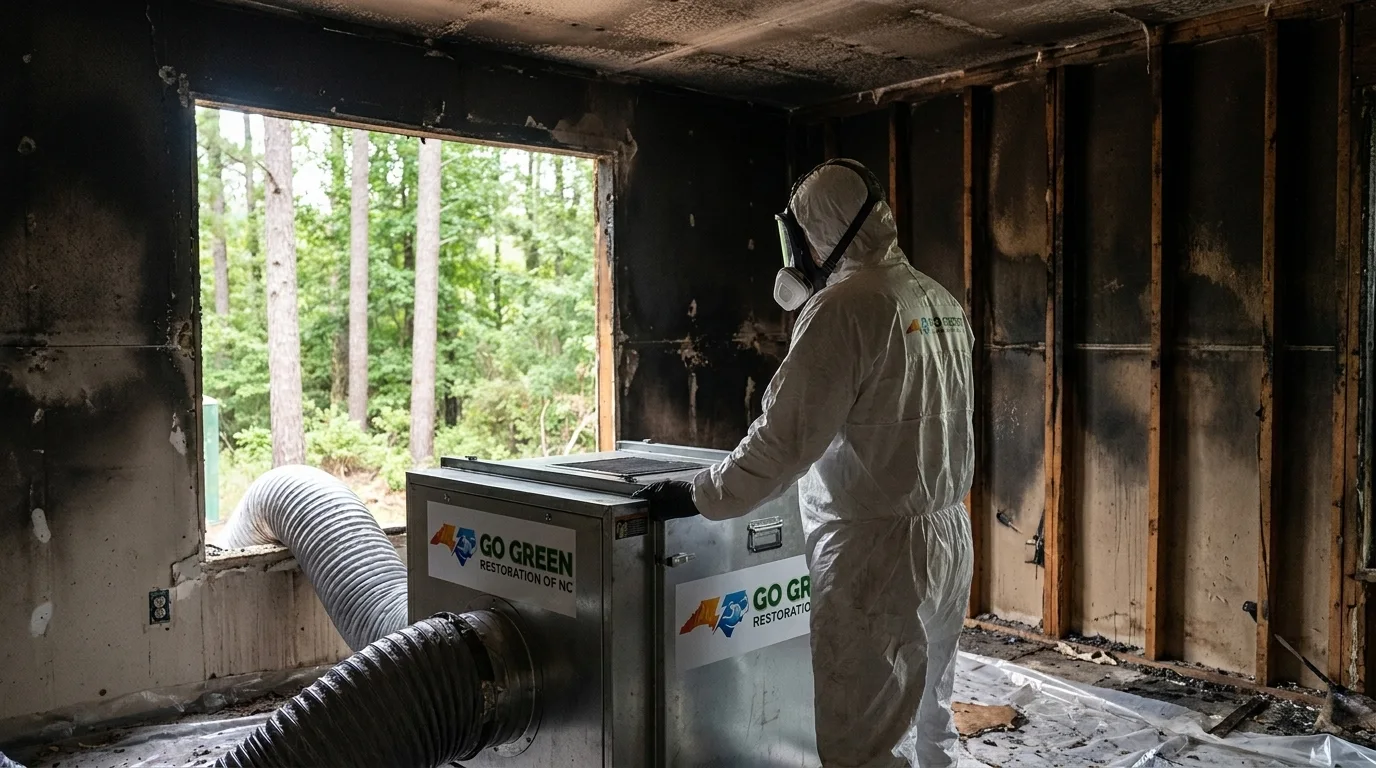
Fire Damage Restoration in Wake Forest
24/7 fire damage restoration in Wake Forest, NC. Insurance billing accepted. Call (919) 906-5473.
Our technicians are dispatched from our Middlesex, NC headquarters and are typically on-site in Wake Forest within 60 minutes of your call.
Wake Forest has grown faster than almost any town in the Triangle, and that growth shows up in the housing stock: subdivisions like Heritage and Traditions are packed with vinyl-sided, wood-framed homes built in the last two decades, construction that burns quickly and traps smoke deep into attic insulation and ductwork before a fire is even fully extinguished. When a kitchen fire or electrical fault ignites one of these homes in the 27587 ZIP code, the damage rarely stops at the charred surfaces you can see. Go Green Restoration of NC responds 24/7 to fire and smoke damage throughout Wake Forest, working to stop secondary damage before it compounds the loss.
Why Wake Forest Properties Face Distinct Fire Damage Challenges
The same building boom that transformed Wake Forest from a small historic town into one of Wake County’s fastest-growing communities also created a specific fire-damage profile. Newer wood-frame construction in subdivisions like Traditions uses engineered lumber and OSB sheathing that can lose structural integrity faster under heat than older-growth dimensional lumber. Attic spaces in these homes are often heavily insulated with blown-in fiberglass or cellulose, materials that absorb smoke odor and soot particles and hold them long after the visible fire is out.
The Historic Downtown Wake Forest area presents a different set of challenges. Older structures near the Wake Forest Historic District may have original wood siding, plaster-and-lath interior walls, and balloon-frame construction, a framing style where wall cavities run uninterrupted from the foundation to the roofline, allowing fire and smoke to travel vertically with little resistance. Restoration work in these buildings requires careful attention to hidden smoke migration that thermal imaging can reveal but a visual inspection alone will miss.
Wake Forest’s climate adds another layer. Hot, humid summers mean that water used in firefighting, or left behind in suppression systems, can begin promoting mold growth within 24 to 48 hours if structural drying doesn’t start promptly alongside smoke and soot remediation.
Our Fire Damage Restoration Process in Wake Forest
Every fire loss is different, but the sequence of work follows a disciplined order. The first priority on arrival is a safety assessment: checking for structural compromise, active hot spots, and utility hazards before any restoration crew enters. Once the structure is cleared, we document the full scope of damage with photographs and moisture readings, documentation that feeds directly into the insurance claim file.
Soot and smoke residue behave differently depending on what burned. Synthetic materials common in newer Wake Forest homes, foam insulation, vinyl flooring, composite cabinetry, produce a wet, oily soot that smears if wiped incorrectly and penetrates porous surfaces aggressively. Protein-based smoke from kitchen fires leaves an almost invisible film that carries a persistent odor. Our technicians identify the soot type before selecting cleaning agents and methods, because the wrong approach can drive residue deeper into drywall or wood rather than removing it.
Structural drying runs concurrently with smoke remediation. Water from suppression efforts soaks into subfloors, wall cavities, and insulation, and in Wake Forest’s humid summers that moisture needs to be extracted and monitored before reconstruction begins. After cleaning and drying are complete, we coordinate any necessary reconstruction, from replacing drywall and insulation to restoring cabinetry and flooring, so the project doesn’t stall between mitigation and rebuild.
Reaching Wake Forest from Middlesex
Go Green Restoration of NC is based in Middlesex, NC. Wake Forest sits to the northwest via US-264 West and US-1 North, a route that keeps response times reasonable across the 27587 area. Whether a call comes from a home near E. Carroll Joyner Park or from one of the newer streets being built at the edges of Heritage, our team is dispatched around the clock, 24 hours a day, seven days a week, because fire damage doesn’t wait for business hours and neither do we.
Insurance Coordination for Wake Forest Fire Claims
Fire claims in Wake County typically involve a homeowner’s insurance adjuster, and the documentation we generate from day one is built with that process in mind. We photograph every affected surface, log moisture readings, and prepare a detailed scope of work that aligns with standard insurance line-item formats. If your policy includes additional living expense coverage, we can help clarify what the remediation timeline looks like so you and your adjuster are working from the same information. We bill carriers directly and work to keep out-of-pocket surprises to a minimum.
Local Note
In Wake Forest’s newer subdivisions, ductwork runs extensively through attic spaces that sit just above living areas, and those ducts act as a highway for smoke during a fire. Soot and odor-carrying particles get pulled into the HVAC system and deposited throughout the duct network even in rooms that saw no direct fire damage. On post-fire jobs in Heritage and similar communities, we inspect and often clean or seal ductwork as part of the odor remediation scope, because restarting an HVAC system before that step can redistribute smoke residue and odor to every room in the house.
If you’re dealing with fire or smoke damage in Wake Forest, call Go Green Restoration of NC at (919) 906-5473. We’ll assess the damage, explain what comes next, and get the work started, so your home or property can move from loss to restored as efficiently as possible.
Fire Damage Restoration in Wake Forest: Service Coverage
Frequently Asked Questions
How fast can you arrive for fire damage restoration in Wake Forest?
How quickly can Go Green Restoration reach a fire damage emergency in the Heritage or Traditions neighborhoods of Wake Forest?
Wake Forest has a lot of newer construction — does that affect how fire damage restoration is handled?
Are older homes near the Wake Forest Historic District restored differently after a fire?
What type of soot is most common in residential fires in Wake Forest, and why does it matter?
Will my Wake County homeowner's insurance cover fire damage restoration, and how does Go Green handle the claim process?
Fire Damage Restoration response in Wake Forest
Most Wake Forest calls see a technician on-site within 60 minutes from our Middlesex headquarters.