
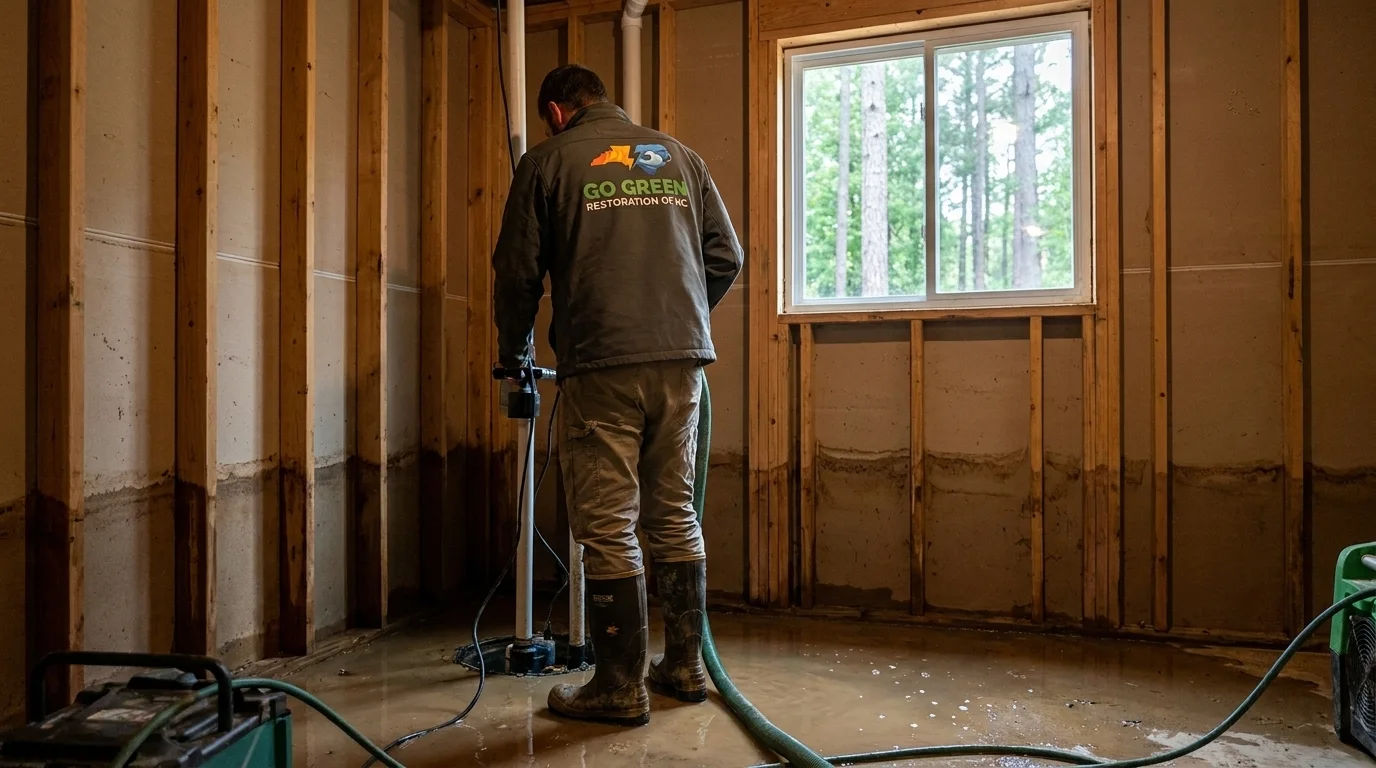
24/7 Emergency Basement Flooding Cleanup in Middlesex
24/7 emergency basement flooding cleanup in Middlesex and surrounding areas. Insurance billing accepted. Call (919) 906-5473.
Basement flooding in Middlesex? We answer 24/7 at (919) 906-5473. Basement flooding rarely gives much warning: a sump pump quits during a storm, groundwater pushes through a hairline foundation crack, or a washing machine supply line lets go while you’re at work. By the time you notice, water has often been sitting against framing, insulation, and stored belongings for hours, and the clock on mold growth is already running. Basement flooding cleanup is its own discipline because basements trap water against masonry, hold humidity longer than any other part of the house, and hide damage behind finished walls and flooring until it’s already spread.
What Basement Flooding Cleanup actually involves
A flooded basement is a different job than a burst pipe upstairs. Water in a below-grade space sits against concrete or block foundation walls that are already porous, soaks into sill plates and bottom-plate framing, and wicks up drywall and paneling far above the visible waterline. Standing water has to come out first, usually with truck-mount or submersible pumps depending on depth, followed by extraction from carpet, pad, and any finished flooring. After extraction, the real work starts: pulling baseboards and drilling weep holes in drywall so trapped water can escape the wall cavity, setting up high-capacity dehumidifiers sized to the cubic footage of the space, and running air movers to keep surface air exchanging across wet materials. Depending on how long water sat and what it contacted (sewage backup, groundwater, or clean supply-line water), some drywall, insulation, and flooring may need to come out rather than dry in place. Drying a basement typically runs several days to over a week because concrete and block hold moisture longer than wood framing in a main-floor space.
Our process
- Water category and source identification. We confirm whether the water is clean groundwater, gray water, or sewage-contaminated, since that determines what can be dried versus what has to be removed.
- Extraction. Pumps and extraction equipment remove standing and surface water from the floor, carpet, and any flooring assemblies before drying equipment goes in.
- Selective demolition. Baseboards, affected drywall, and saturated insulation are removed where moisture has tracked above the visible waterline, so drying equipment isn’t fighting trapped water behind a finished wall.
- Structural drying and monitoring. Dehumidifiers and air movers are placed and sized to the space, and moisture readings in framing, subfloor, and masonry are logged daily and dried per the IICRC S500 standard until materials reach a stable, dry baseline.
- Final verification and reassembly notes. Once readings confirm the space is dry, we document the results and scope out any rebuild needed before trim, drywall, or flooring goes back.
What separates a good basement flooding response from a bad one
The most common mistake is treating a basement like any other room: running a few fans, calling it dry when the carpet feels dry to the touch, and closing the job before block walls and framing have actually released their moisture. Concrete and masonry release water slowly, and surface-dry readings can mask a wet wall cavity for weeks, which is exactly how mold colonies establish behind baseboards and inside insulation. A thorough response pulls baseboards and checks moisture at the stud and sill plate level, not just at floor height, and keeps monitoring equipment in place until readings are consistent across multiple visits, not just one. Insurance adjusters reviewing a basement claim look for documented moisture logs over time, photos of the source and extent of damage, and a clear explanation for any materials removed rather than dried. Skipping that documentation is one of the fastest ways a claim gets questioned.
What does Basement Flooding Cleanup cost?
Costs vary with how much water came in, how long it sat, whether the basement is finished, and whether the source was clean water or contaminated. These are typical industry ranges, not a quote: every basement and every loss is different, and Go Green Restoration of NC provides a written scope before any work begins. Homeowners insurance typically covers sudden and accidental water losses like a failed sump pump or burst supply line, but routine groundwater seepage or flood-related water is often excluded unless a separate flood policy is in place.
| Scenario | Typical range |
|---|---|
| Unfinished basement, few inches of clean water | $1,500 - $3,500 |
| Finished basement, carpet and drywall affected | $3,500 - $8,000 |
| Deep flooding with contaminated water | $6,000 - $15,000+ |
| Mold growth present from a delayed response | $2,500 - $7,500 (additional) |
| Sump pump or French drain failure requiring repair | $800 - $3,000 (separate from cleanup) |
Seasonal & regional considerations
Middlesex sits in the Coastal Plain, where clay-heavy soil drains slowly and the water table sits close to the surface for much of the year. That combination means basements and crawl spaces in this area deal with hydrostatic pressure against foundation walls even without a major storm, and heavy regional rain events can push groundwater through foundation cracks or around window wells with little warning. Older homes in the area built with block foundations are especially prone to seepage once mortar joints age, so a sump pump that’s kept up fine for years can suddenly fall behind during a heavier-than-usual rain season.
Service area
We respond to basement flooding throughout Middlesex and the surrounding Nash and Wilson County communities.
If water is sitting in your basement right now, don’t wait to see if it dries on its own. Call (919) 906-5473 to schedule basement water removal and get drying equipment on-site before the damage spreads past what you can see.
Frequently Asked Questions
Does homeowners insurance cover basement flooding cleanup?
How long does it take to dry out a flooded basement?
Why do you remove baseboards and drywall after a basement flood?
What's the difference between clean water and contaminated basement flooding?
What should I do while waiting for a basement flooding crew to arrive?
Will a flooded basement lead to mold if it's cleaned up quickly?
Looking for the best basement flooding cleanup company in Middlesex?
Go Green Restoration of NC provides basement flooding cleanup in Middlesex, NC and the surrounding area. We answer calls 24/7 — call (919) 906-5473 for immediate help.
Need Basement Flooding Cleanup now?
We respond 24/7 across Middlesex and surrounding NC cities.
Related Coverage
- Our Restoration Services
- Contact Go Green Restoration of NC
- Restoration Services in Archer Lodge
- Restoration Services in Clayton
- Restoration Services in Durham
- Restoration Services in Elm City
- Restoration Services in Kenly
- Restoration Services in Knightdale
- Restoration Services in Lake Royale
- Restoration Services in Louisburg
- Restoration Services in Nashville
- Restoration Services in Pine Level
- Restoration Services in Raleigh
- Restoration Services in Rocky Mount