
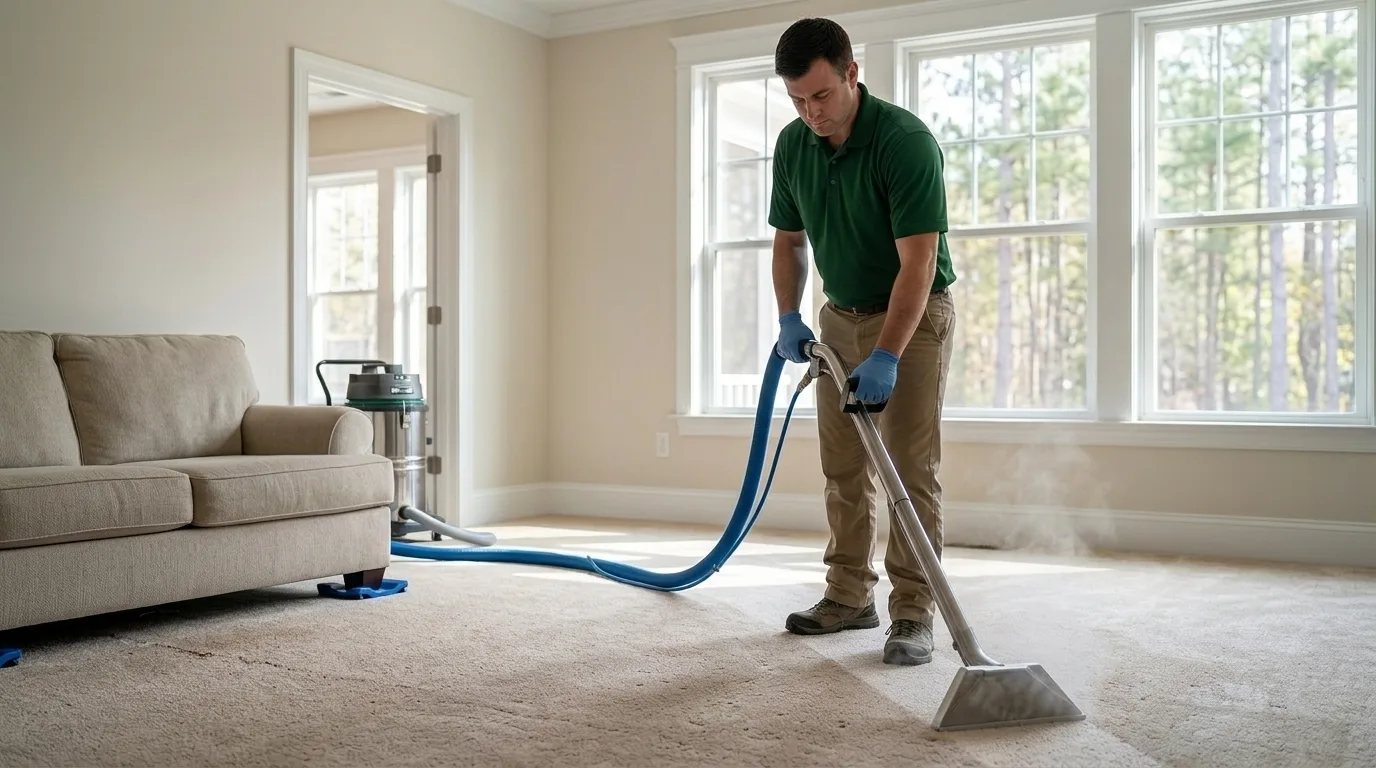
Carpet Cleaning in Middlesex
24/7 carpet cleaning in Middlesex and surrounding areas. Insurance billing accepted. Call (919) 906-5473.
Carpet fibers trap more than dirt, they hold pet dander, bacteria, mold spores, and odor-causing residue that a vacuum can’t reach. After a water intrusion, a pet accident that soaked through to the pad, or years of foot traffic ground into the pile, the surface may look passable while the backing and subfloor underneath are quietly harboring the real problem. Professional carpet cleaning gets into the fiber structure and the pad layer where everyday maintenance stops.
What carpet cleaning actually involves
Deep carpet cleaning is not the same process as the rental-machine pass most homeowners have tried. Hot-water extraction, the method that moves the most contamination out of the fiber, uses truck-mounted or high-capacity portable equipment to inject a heated cleaning solution under pressure and immediately vacuum it back out, pulling suspended soils, allergens, and residues with it. The water temperature and dwell time matter: cold or lukewarm machines leave behind the oily residue that causes rapid re-soiling. Fiber type also changes the approach, nylon and polyester tolerate aggressive heat and agitation; wool and natural-fiber rugs require lower temperatures and pH-neutral chemistry to avoid shrinkage and dye bleed.
For stain removal, pre-treatment is where most of the outcome is decided. Protein stains (blood, pet urine, food) respond to enzyme-based treatments that break down the organic compound before extraction. Tannin stains (coffee, red wine, tea) need an acidic pre-spray. Applying the wrong chemistry to the wrong stain type sets the stain permanently, a common mistake that turns a recoverable spot into a replacement conversation.
A typical single-room cleaning takes 20–40 minutes of active work, with dry times running 4–8 hours depending on humidity, airflow, and pile depth. In Middlesex and the surrounding Johnston and Nash County area, summer humidity can push dry times toward the longer end unless fans or air movers are used.
Our process
-
Pre-inspection and fiber identification, Before any water or chemistry touches the carpet, the pile, backing, and any visible staining are assessed. Fiber type determines cleaning temperature, agitation method, and pre-spray chemistry. Moisture readings are taken if there is any history of water intrusion, because cleaning over a wet pad traps moisture and accelerates mold growth.
-
Pre-treatment and dwell time, Stains and high-traffic lanes are treated with the appropriate chemistry, enzyme formulas for organics, alkaline pre-sprays for oily soils, acidic spotters for tannins, and allowed to dwell long enough to break down the soil before extraction begins. Skipping or shortening dwell time is the most common reason carpet looks clean for two weeks and then looks worse than before.
-
Hot-water extraction, Heated water is injected into the pile under pressure and immediately extracted along with loosened soils, pre-spray residue, and suspended allergens. The extraction wand is overlapped on each pass to avoid leaving dry strips. For heavily soiled carpet or post-water-damage situations, a second extraction pass with clean rinse water removes detergent residue that would otherwise attract dirt.
-
Post-treatment and carpet sanitization, Where pet odor, mold risk, or contamination from a water loss is a concern, an EPA-registered sanitizer or enzyme deodorizer is applied after extraction. This step is not cosmetic, it addresses microbial load in the fiber and backing that extraction alone does not eliminate.
-
Grooming and dry-time setup, The pile is groomed with a carpet rake to lift fibers and promote even drying, and air movers are positioned to bring dry times down. Furniture tabs or foam blocks are placed under legs to prevent rust or dye transfer during drying.
What separates a good carpet cleaning from a bad one
The most common failure point is over-wetting, leaving too much moisture in the pad and backing. Rental machines and undertrained operators frequently do this. Wet pad that does not dry within 24–48 hours begins to support mold and bacteria growth, and the odor that follows is worse than what the cleaning was meant to fix. Proper extraction means the carpet feels slightly damp to the touch, not wet.
The second common failure is chemistry mismatch. Using a high-alkaline pre-spray on wool or a protein enzyme on a synthetic dye stain damages fibers or sets the stain. Experienced technicians identify the fiber and the stain type before selecting chemistry, not after.
For insurance-related losses (water damage, sewage backup, fire suppression water), documentation matters as much as the cleaning itself. Adjusters want to see pre-cleaning moisture readings, photographic evidence of contamination, and a written scope that distinguishes cleanable carpet from carpet that needs replacement. Carpet that has been wet for more than 48–72 hours, or that was contacted by Category 2 or Category 3 water (sewage, floodwater), typically cannot be restored to a sanitary condition and should be documented for replacement rather than cleaned.
What does carpet cleaning cost?
Typical costs depend heavily on square footage, soil level, fiber type, and whether the work is part of a larger water or fire loss. Most homeowners pay in the ranges below for standard professional carpet cleaning; restoration-related cleaning (post-water-damage, sewage, or fire suppression) runs higher because of the additional documentation, sanitization, and equipment involved. These are industry-typical figures, every loss is different, and Go Green Restoration of NC provides a written scope before any work begins so there are no surprises.
Homeowners insurance typically covers carpet cleaning when it is part of a covered loss (water damage, fire, or sewage backup), it does not cover routine cleaning or wear-and-tear.
| Scenario | Typical industry range |
|---|---|
| Single room, routine deep cleaning | $75 – $150 |
| Whole home (1,200–1,800 sq ft) | $250 – $500 |
| Pet odor treatment + extraction | $300 – $600 |
| Post-water-damage cleaning (Category 1) | $400 – $900 |
| Sewage or Category 3 water contact | $600 – $1,500+ |
| Commercial carpet cleaning (per 1,000 sq ft) | $150 – $400 |
Seasonal and regional considerations
Middlesex sits in a humid subtropical climate where summer relative humidity regularly exceeds 70%. High ambient humidity slows carpet dry times significantly, a carpet that dries in five hours in January can take nine or ten hours in July without supplemental airflow. This matters because extended drying windows increase the risk of mold colonization in the pad and backing. Air movers and dehumidifiers are standard equipment on any summer cleaning job, not an upsell. Spring and early summer also bring peak pollen counts in the Triangle and surrounding counties, making carpet sanitization particularly relevant for households with allergy or asthma concerns during those months.
Service area
Go Green Restoration of NC is based in Middlesex, NC and provides carpet cleaning and carpet sanitization services throughout the surrounding area, including communities in Johnston, Nash, Wake, and Wilson counties. The city-specific pages for nearby areas link back here for full service details, if you are searching for carpet cleaning in a neighboring town, you are in the right place.
Ready to get the contamination, odor, and ground-in soil out of your carpet for good? Call Go Green Restoration of NC at (919) 906-5473 to schedule your deep carpet cleaning and get a written scope before any work begins.
Frequently Asked Questions
Does homeowners insurance cover carpet cleaning?
My carpet got wet during a water loss. Can it be cleaned and saved, or does it need to be replaced?
What is hot-water extraction, and is it the same as steam cleaning?
Why does my carpet look dirty again just a few weeks after it was cleaned?
How long should I stay off the carpet after a professional cleaning, and how can I speed up drying?
Looking for the best carpet cleaning company in Middlesex?
Go Green Restoration of NC provides carpet cleaning in Middlesex, NC and the surrounding area. We answer calls 24/7 — call (919) 906-5473 for immediate help.
Need Carpet Cleaning now?
We respond 24/7 across Middlesex and surrounding NC cities.