
Industrial Restoration in Middlesex
24/7 industrial restoration in Middlesex and surrounding areas. Insurance billing accepted. Call (919) 906-5473.
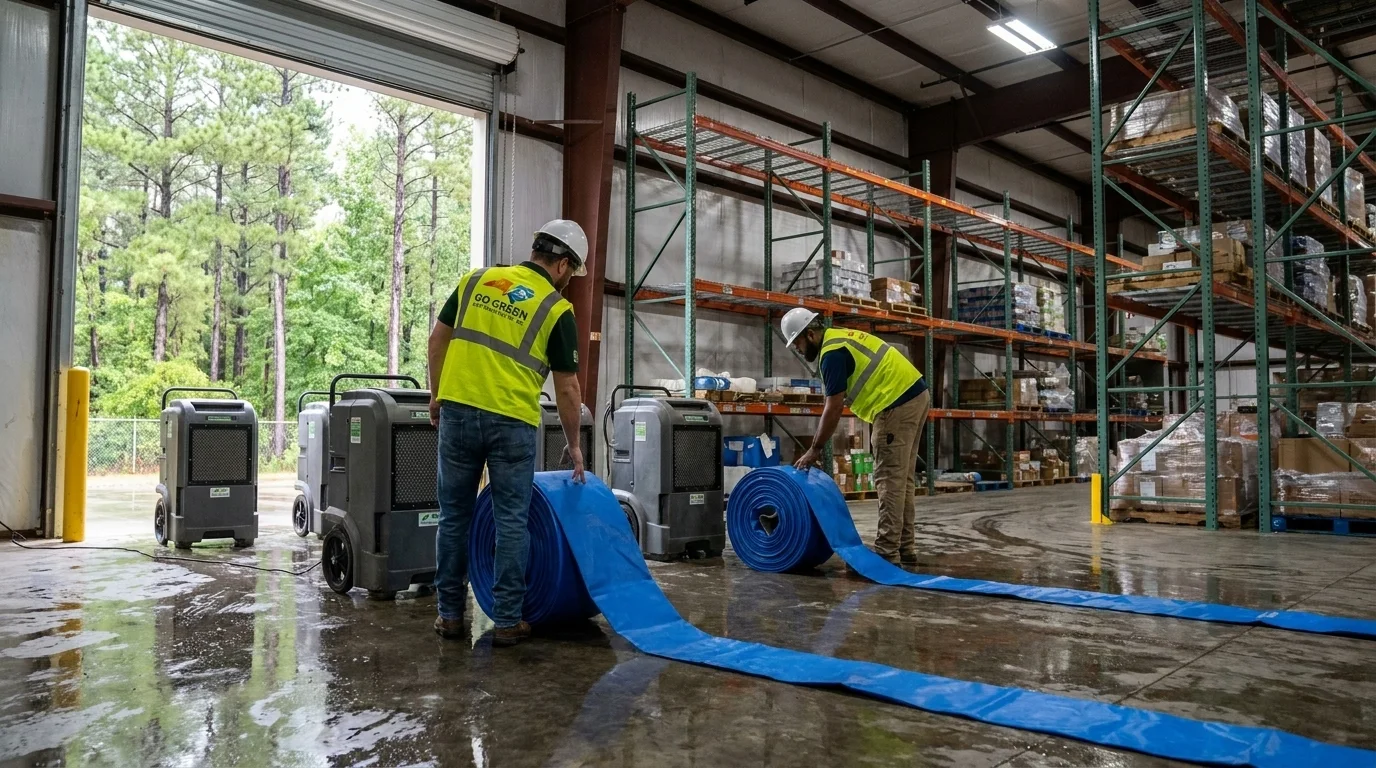
Industrial water damage in a manufacturing plant or warehouse behaves differently than a residential flood. A burst supply line above a production floor doesn’t just soak drywall, it tracks under equipment pads, pools in slab control joints, and wicks into electrical conduit runs before anyone notices standing water. By the time a facility manager spots it, corrosion has often already started on exposed metal, and every hour of downtime is a production cost on top of the physical damage. Go Green Restoration of NC works these losses at the scale they require, with equipment sized for tens of thousands of square feet, not a single bedroom.
What Industrial Restoration actually involves
Industrial and commercial-scale losses, warehouse flooding, plant fire damage, manufacturing facility water intrusion, are a different category of work from residential restoration. The square footage is larger, the structural assemblies are different (tilt-up concrete, steel frame, exposed slab), and there’s usually equipment, inventory, or active production lines in the loss zone that can’t just be set aside. Drying a 40,000-square-foot warehouse floor means moisture mapping across multiple zones, not one hygrometer reading. Fire damage in a plant setting means dealing with soot that may have traveled through HVAC trunk lines into areas far from the original source. Response is sized to the facility: large-capacity extraction units, commercial dehumidification matched to cubic footage, and air movers placed by zone rather than by room.
Timelines run longer than a typical home loss, too. Structural drying on a concrete slab with saturated subfloor or built-up flooring can take longer than drywall and wood framing because concrete releases moisture slowly and unevenly. Facility managers are usually balancing restoration against a production or shipping schedule, so sequencing work to bring sections back online while drying continues elsewhere matters as much as the drying itself.
Our process
- Facility walkthrough and loss mapping. We identify every affected zone, not just the visible one, including machinery footprints, electrical panels, raised flooring, and areas where water or smoke may have migrated through HVAC or conduit penetrations.
- Large-scale extraction and zoned drying. Industrial-capacity extraction and dehumidification equipment is deployed by zone, with moisture readings logged across the slab, subfloor, and any affected framing so drying can be verified with data, not guesswork.
- Equipment and asset protection. Exposed metal, electrical components, and machinery near the loss are treated to slow corrosion while drying continues, since oxidation on bearings, panels, and conduit can start within hours of a water event.
- Fire and smoke-specific cleanup where applicable. Soot characterization, thermal fogging, and HVAC system cleaning address smoke migration that can travel well beyond the original fire zone in a facility with central air handling.
- Reconstruction and return-to-operation coordination. Repairs are scheduled in sections where possible, so parts of the facility can resume operation while remaining work continues, with documentation at each stage for the business interruption claim.
What separates a good industrial restoration response from a bad one
The most common mistake in large-loss work is treating it like a residential job at bigger scale. A crew without industrial experience will dry the visible surfaces and miss moisture trapped under equipment pads or inside slab control joints, which shows up as a mold or corrosion problem weeks later. Another frequent gap is documentation: adjusters on commercial and industrial claims expect zone-by-zone moisture logs, photos tied to a facility layout, and equipment placement records, not a single summary sheet. Facilities that skip this step often end up disputing scope with their carrier later.
Good operators also plan drying and reconstruction around the facility’s operational needs from day one, coordinating with plant management on which zones can be sectioned off and dried first versus which need to come back online fastest. That sequencing decision, made early, is often the difference between a facility losing days of production versus weeks.
What does industrial restoration cost?
Industrial losses vary enormously based on square footage, the type of loss, and whether machinery or inventory is affected, so costs are harder to generalize than a residential job. The ranges below reflect typical industry figures for commercial and industrial-scale losses, not a quote. Every facility is different, and Go Green Restoration of NC provides a written scope of work before any work begins so there are no surprises. Commercial property insurance typically covers sudden water and fire losses and often includes business interruption coverage, but coverage for gradual damage or equipment failure varies by policy.
| Scenario | Typical range |
|---|---|
| Localized water intrusion, single warehouse bay | $3,000 - $9,000 |
| Large-scale flooding across a plant floor | $15,000 - $60,000+ |
| Fire damage to a production line or equipment area | $20,000 - $100,000+ |
| Smoke damage through HVAC in a multi-zone facility | $8,000 - $35,000 |
| Multi-building industrial complex, major loss | $100,000+ |
Seasonal & regional considerations
Eastern North Carolina’s humidity means industrial facilities with large open floor areas, warehouses, distribution centers, agricultural processing buildings, are especially prone to condensation-related corrosion and slow concrete drying after a water event. Summer storm season brings a higher risk of roof leaks and power interruptions that can affect refrigeration or climate-controlled storage, which compounds a water loss if it isn’t caught quickly. Facilities near Middlesex with older steel-frame or tilt-up construction should also expect drying times to run longer than newer buildings with modern vapor barriers.
Service area
Go Green Restoration of NC responds to industrial and commercial losses throughout Middlesex and the surrounding region, including facilities in and around Wilson, Zebulon, Smithfield, and Rocky Mount. We answer 24/7 and bring equipment sized for the facility, whether that’s a single warehouse bay or a full production complex.
If your facility has active water intrusion, smoke migration, or fire damage, get a written scope of work started before the loss spreads further. Call Go Green Restoration of NC to schedule an industrial facility assessment.
Frequently Asked Questions
Does commercial or industrial property insurance cover restoration after a plant or warehouse loss?
How is drying different for a warehouse or plant floor compared to a house?
Can part of our facility stay operational while restoration work is happening?
How quickly does corrosion start on machinery or electrical components after a water event?
What does Go Green Restoration of NC need from us to document a business interruption claim?
Looking for the best industrial restoration company in Middlesex?
Go Green Restoration of NC provides industrial restoration in Middlesex, NC and the surrounding area. We answer calls 24/7 — call (919) 906-5473 for immediate help.
Need Industrial Restoration now?
We respond 24/7 across Middlesex and surrounding NC cities.
Related Coverage
- Our Restoration Services
- Contact Go Green Restoration of NC
- Restoration Services in Archer Lodge
- Restoration Services in Clayton
- Restoration Services in Durham
- Restoration Services in Elm City
- Restoration Services in Kenly
- Restoration Services in Knightdale
- Restoration Services in Lake Royale
- Restoration Services in Louisburg
- Restoration Services in Nashville
- Restoration Services in Pine Level
- Restoration Services in Raleigh
- Restoration Services in Rocky Mount