
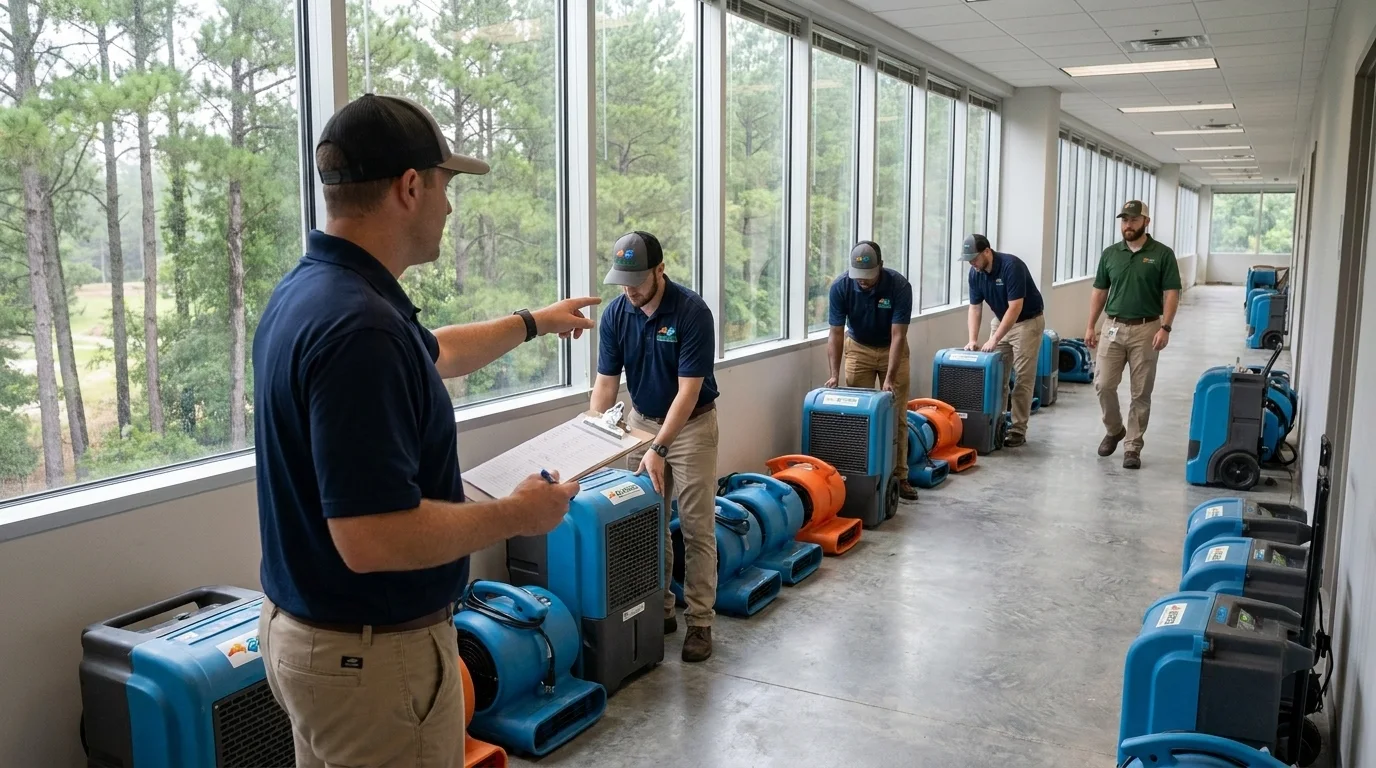
Large Loss and Catastrophic Response in Middlesex
24/7 large loss and catastrophic response in Middlesex and surrounding areas. Insurance billing accepted. Call (919) 906-5473.
When a loss spans multiple units, multiple floors, or multiple structures, the usual mitigation playbook stops working. A single crew with a few air movers can’t keep pace with a flooded apartment building, a commercial fire that’s taken out an entire wing, or an HOA property where a storm damaged a dozen units at once. Large loss and catastrophic response is built for that scale: coordinated crews, phased mitigation, and documentation detailed enough to hold up through a large-loss claim review.
What Large Loss and Catastrophic Response actually involves
A large loss is generally defined by scope and dollar value, not by a single category of damage. It might be a commercial building fire with smoke traveling through HVAC into occupied units, a broken main that floods a parking garage and three floors above it, or storm damage affecting an entire residential complex. These losses almost always involve multiple trades, multiple insurance stakeholders, and a timeline measured in weeks rather than days.
The work itself still rests on the same core disciplines: water extraction, structural drying, soot and odor remediation, debris removal. What changes is the scale of equipment deployed (multiple desiccant dehumidifiers and air movers running in parallel across zones), the number of crews on site at once, and the amount of coordination required between property managers, large loss adjusters, and sometimes multiple insurance carriers if the property has different coverage for different units or common areas. Moisture mapping has to cover every affected unit separately, since drying conditions in a ground-floor unit under a slab rarely match a third-floor unit under a flat roof.
Our process
- Mobilization and scene triage. Crews and equipment are staged based on the size and layout of the loss, prioritizing areas where secondary damage is advancing fastest, such as units directly below an active leak or adjacent to fire-damaged walls.
- Full-scope documentation. Every affected unit or zone gets its own moisture readings, photos, and damage notes, built into a line-item scope that large loss adjusters can review and verify against the physical site.
- Phased mitigation across zones. Rather than treating the property as one undifferentiated job, drying and cleanup happen in defined phases or pods, which keeps contamination from spreading between unaffected and affected units and lets some areas come back online sooner.
- Ongoing project management. Daily logs, moisture tracking, and scheduled adjuster walkthroughs keep the claim and the physical work moving together instead of the paperwork trailing weeks behind the mitigation.
- Handoff to reconstruction. Once drying and cleaning are verified complete, a documented scope of work is handed off for rebuild, with records organized so the transition doesn’t require re-scoping from scratch.
What separates a good large loss response from a bad one
The most common failure on big losses isn’t bad technique, it’s under-resourcing. A crew sized for a single-family water loss simply can’t keep up with a 40-unit building, and the gap shows up two weeks later as hidden mold in wall cavities nobody had equipment on long enough to dry. Documentation gaps are the other recurring problem: adjusters reviewing large claims expect unit-by-unit moisture logs, dated photos, and a clear scope, not a single summary covering an entire property. When that documentation is thin, claims stall or get disputed over scope.
Good large loss response also means thinking about occupancy and business interruption from day one, sequencing work so habitable or operational areas are restored first where it’s safe to do so, and keeping lines of communication open between the property owner, the insurance carrier, and anyone managing tenants or occupants. Cross-contamination between affected and unaffected units, from dragging wet equipment or debris through clean hallways, is a preventable mistake that shows up often on poorly managed large jobs.
What does Large Loss and Catastrophic Response cost?
Large loss costs vary enormously depending on the number of units or structures involved, the category of damage, and how much reconstruction follows mitigation. These are typical industry ranges, not a quote: every loss is different, and Go Green Restoration of NC provides a written scope of work before any work begins. Homeowners and commercial property insurance typically covers large loss mitigation and reconstruction when the cause is a covered peril, though coverage limits and deductibles vary significantly between residential and commercial policies.
| Scenario | Typical range |
|---|---|
| Multi-unit apartment water loss (5-10 units) | $25,000 - $90,000 |
| Commercial building fire, single wing or floor | $75,000 - $300,000 |
| HOA common area storm damage | $15,000 - $60,000 |
| Large residential estate, combined fire and water | $100,000 - $500,000+ |
| Multi-structure catastrophic flood event | $150,000 - $750,000+ |
Seasonal & regional considerations
Eastern North Carolina sees its highest catastrophic risk during hurricane season, roughly August through October, when a single storm can generate losses across an entire neighborhood or commercial corridor at once. Outside storm season, large losses in this region more often trace back to aging commercial plumbing or a hard freeze that hits multiple units in a complex simultaneously, since pipe runs in older multi-family buildings tend to share exposure to the same unheated spaces.
Service area
Go Green Restoration of NC responds to large loss and catastrophic events from its base in Middlesex, serving surrounding Nash, Wilson, and Johnston County communities, including the commercial corridors and multi-family properties along the Wilson and Smithfield areas.
If you’re managing a loss that’s bigger than a single unit or a single room, call (919) 906-5473 to get a large loss team mobilized and a documented scope started before the damage spreads further.
Frequently Asked Questions
Does homeowners or commercial insurance cover large loss and catastrophic response?
How is a large loss claim documented differently from a standard residential claim?
Why does a large loss need multiple crews instead of one larger crew rotating through?
How does a phased or pod-based approach prevent cross-contamination between units?
What should a property manager do while waiting for a large loss team to mobilize?
Looking for the best large loss and catastrophic response company in Middlesex?
Go Green Restoration of NC provides large loss and catastrophic response in Middlesex, NC and the surrounding area. We answer calls 24/7 — call (919) 906-5473 for immediate help.
Need Large Loss and Catastrophic Response now?
We respond 24/7 across Middlesex and surrounding NC cities.
Related Coverage
- Our Restoration Services
- Contact Go Green Restoration of NC
- Restoration Services in Archer Lodge
- Restoration Services in Clayton
- Restoration Services in Durham
- Restoration Services in Elm City
- Restoration Services in Kenly
- Restoration Services in Knightdale
- Restoration Services in Lake Royale
- Restoration Services in Louisburg
- Restoration Services in Nashville
- Restoration Services in Pine Level
- Restoration Services in Raleigh
- Restoration Services in Rocky Mount