
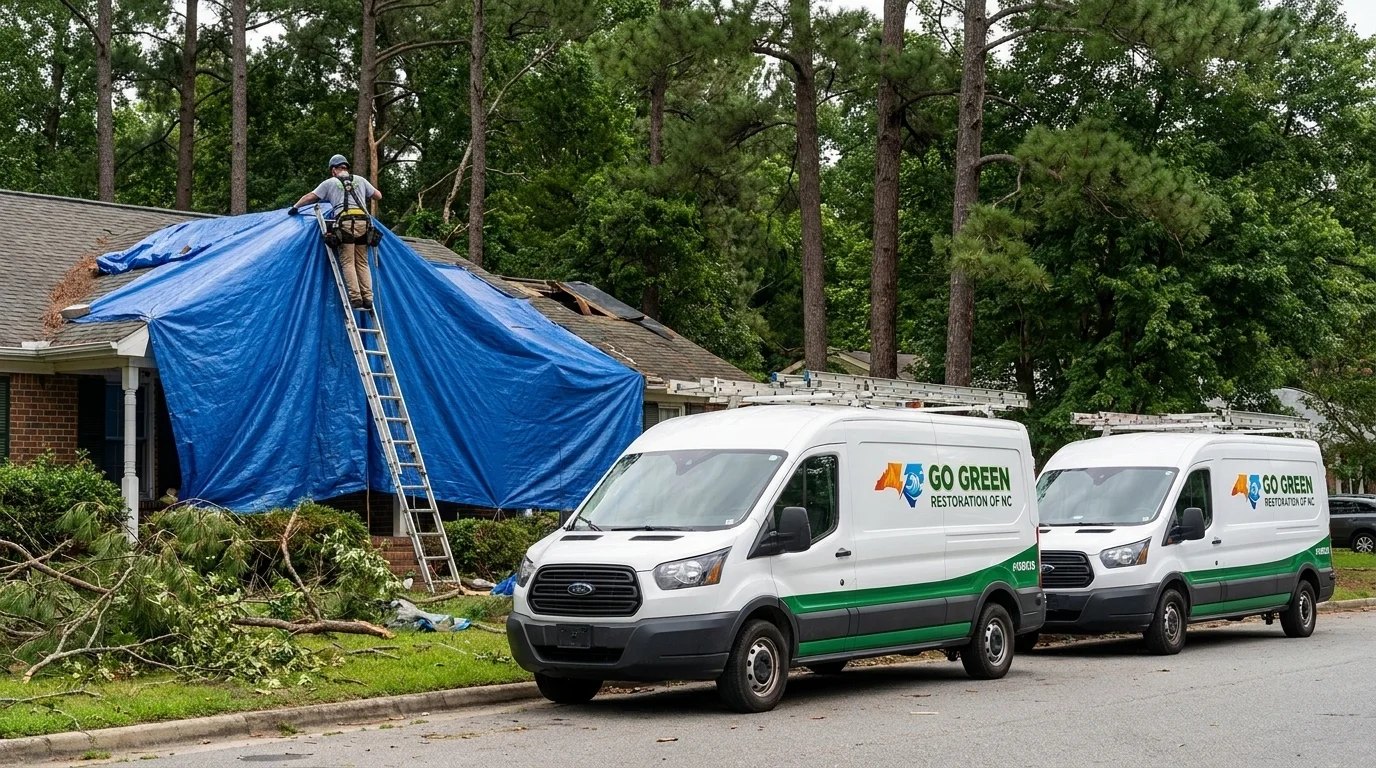
24/7 Emergency Storm Damage Restoration in Middlesex
24/7 emergency storm damage restoration in Middlesex and surrounding areas. Insurance billing accepted. Call (919) 906-5473.
Storm damage emergency in Middlesex? We answer 24/7 at (919) 906-5473. A downed limb through the roof deck, wind-driven rain forcing its way under shingles and flashing, or a transformer pop that knocks out sump pumps during a downpour, each of these turns into a much bigger repair the longer water sits against drywall, insulation, and framing. The first 24 to 48 hours after a storm decide whether you’re dealing with a roof patch or a full interior rebuild.
What Storm Damage Restoration actually involves
Storm damage is rarely one problem. It’s usually wind, water, and debris arriving together, and each one needs a different response. A tree limb punching through a roof deck creates an open path for rain even after the storm passes. Wind-driven rain can push water sideways under siding and shingles without any visible hole at all, soaking sheathing and insulation that looks fine from inside the house. Downed power lines or flooded crawlspaces add electrical and structural hazards on top of the water problem.
Our crews stabilize the structure first: emergency tarping over roof openings, board-up for broken windows or doors, and water extraction from affected rooms. From there it’s the same moisture tracking and structural drying used on any water loss, but with an added layer of documentation because storm claims get more adjuster scrutiny than a simple pipe burst. Equipment includes heavy-duty tarps rated for wind, plywood board-up materials, extraction pumps, and the same air movers and dehumidifiers used in standard water drying, sized to the affected square footage.
Our process
- Emergency stabilization. Tarping over roof damage, board-up on broken windows or doors, and shutting off power or water to the affected area if it’s unsafe.
- Water intrusion assessment. We check not just where water is visibly pooling but where wind-driven rain may have pushed moisture into wall cavities, attic insulation, and subfloor, using moisture meters and thermal imaging.
- Debris and tree coordination. For trees on or against the structure, we coordinate removal with the priority of preventing further structural movement or roof collapse before extraction and drying begin.
- Structural drying and moisture mapping. Air movers and dehumidifiers are placed and monitored daily until materials read dry, not just damp-to-the-touch.
- Documentation and claim support. Photos of wind damage, debris impact, and water intrusion are logged before and during tarping and drying, since this is often the evidence an adjuster needs to separate storm damage from pre-existing conditions.
What separates a good storm damage response from a bad one
The biggest mistake we see is treating storm damage as a roofing problem only. A tarp stops new rain from getting in, but it does nothing for the water that already soaked into insulation and sheathing before the tarp went up. If that moisture isn’t tracked and dried, mold can start colonizing within 24 to 48 hours in warm, humid conditions, which is most of the year in this part of North Carolina.
Another common gap is documentation timing. Adjusters distinguish between wind damage (typically covered) and flood damage from rising water (often excluded or requiring separate flood coverage), and that distinction depends heavily on photos taken before cleanup starts. Tarping or removing debris without documenting it first can cost a homeowner part of their claim. A thorough response photographs damage, measures moisture before and after drying, and keeps a clear record of what was wind versus what may have been ground or surface water.
What does Storm Damage Restoration cost?
Costs vary widely depending on whether the damage is limited to roof and exterior, or whether water reached interior finishes and framing. Every loss is different, which is why Go Green Restoration of NC provides a written scope of work before any repair begins. Homeowners insurance typically covers wind and wind-driven rain damage under standard policies, while flood damage from rising water usually requires separate flood insurance, so it’s worth confirming your policy terms early in the process.
| Scenario | Typical range |
|---|---|
| Emergency tarp or board-up only | $350 - $1,200 |
| Tree removal from structure, no interior damage | $800 - $3,000 |
| Wind-driven water intrusion, single room | $1,500 - $4,000 |
| Roof damage with multi-room interior water damage | $5,000 - $15,000 |
| Major structural damage from tree impact | $15,000 - $40,000+ |
Seasonal & regional considerations
Central North Carolina sees two distinct storm risks: hurricane season from June through November, when tropical systems can bring days of sustained wind-driven rain, and spring severe thunderstorm season, when fast-moving straight-line winds and occasional tornadoes cause more localized but intense damage. Older tree canopy throughout Nash and Wilson County neighborhoods means mature oaks and pines are a recurring source of roof and structure impact after high-wind events.
Service area
We respond to storm damage throughout Middlesex and the surrounding communities, including Wilson, Zebulon, Bailey, and nearby parts of Nash and Wilson County.
If a storm has already come through and you’re looking at a tarped roof, a downed tree, or water spreading across a ceiling, call (919) 906-5473 for emergency stabilization and get the drying and documentation started before the next rain finds its way back in.
Frequently Asked Questions
Does homeowners insurance cover storm damage restoration?
What's the difference between wind damage and flood damage for insurance purposes?
How fast does secondary water damage start after a storm?
Should I remove a fallen tree from my roof before you arrive?
Why do you photograph everything before tarping or removing debris?
Looking for the best storm damage restoration company in Middlesex?
Go Green Restoration of NC provides storm damage restoration in Middlesex, NC and the surrounding area. We answer calls 24/7 — call (919) 906-5473 for immediate help.
Need Storm Damage Restoration now?
We respond 24/7 across Middlesex and surrounding NC cities.
Related Coverage
- Our Restoration Services
- Contact Go Green Restoration of NC
- Restoration Services in Archer Lodge
- Restoration Services in Clayton
- Restoration Services in Durham
- Restoration Services in Elm City
- Restoration Services in Kenly
- Restoration Services in Knightdale
- Restoration Services in Lake Royale
- Restoration Services in Louisburg
- Restoration Services in Nashville
- Restoration Services in Pine Level
- Restoration Services in Raleigh
- Restoration Services in Rocky Mount