
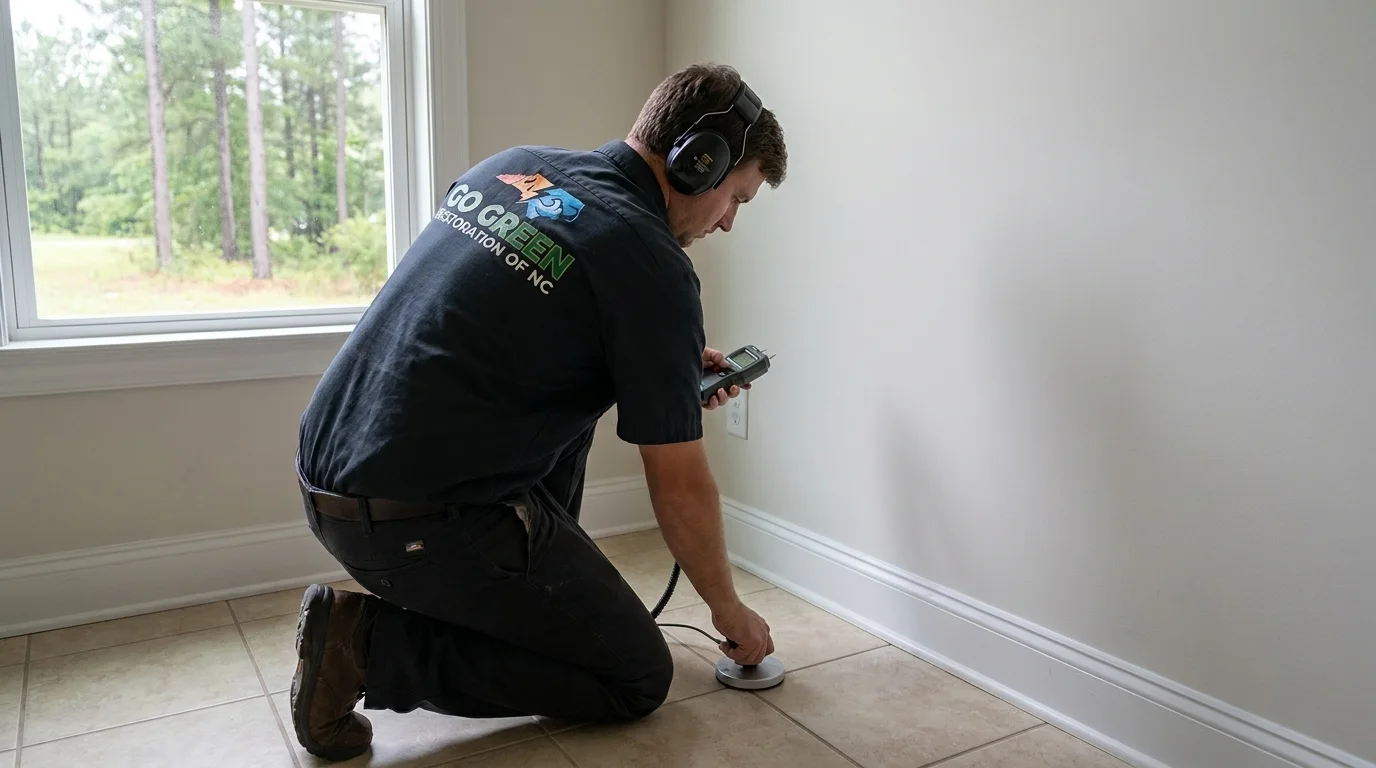
Water Leak Detection in Middlesex
24/7 water leak detection in Middlesex and surrounding areas. Insurance billing accepted. Call (919) 906-5473.
A water bill that jumps for no clear reason, a warm spot on the slab, a musty smell from a closet with no visible moisture: these are the quiet signals of a leak that hasn’t announced itself yet. By the time water stains a ceiling or buckles a floor, it’s often been running behind the wall or under the foundation for weeks. Water leak detection finds that source before it turns into a structural or mold problem, using equipment that reads moisture and temperature differences without opening up every wall in the house.
What Water Leak Detection actually involves
This is diagnostic work, not demolition. A technician uses thermal imaging to spot temperature anomalies behind drywall, acoustic listening devices to pick up the sound of water moving or dripping inside a pipe, and moisture meters to confirm readings at the surface. For a suspected slab leak, we may also use pressure testing on the plumbing line to isolate which run is losing water. The goal at every step is to locate the leak with as little intrusion as possible, then mark the exact spot so any opening cut into drywall, flooring, or slab is small and targeted. A straightforward hidden water leak in a wall cavity can often be pinpointed in under an hour. A slab leak with multiple plumbing runs or a leak that’s migrated along a joist before showing up elsewhere takes longer and may require more than one detection method to confirm.
Our process
- Symptom intake. We ask about water bill history, where staining or smell first appeared, and whether any recent plumbing or appliance work was done, since all of that narrows the search area before equipment ever comes out.
- Moisture mapping. A moisture meter scans walls, flooring, and ceilings near the suspected area to establish a boundary of where elevated moisture exists versus where materials read dry.
- Thermal and acoustic scanning. Infrared imaging flags temperature differentials consistent with moisture or an active leak, and acoustic listening equipment confirms whether water is moving inside a pipe at that location.
- Confirmation and pressure testing. For suspected slab or pressurized-line leaks, we isolate the line and run a pressure test to confirm the leak’s location before any cutting or digging happens.
- Written findings and access point. You get a clear explanation of where the leak is, what’s likely causing it, and the smallest reasonable access point to reach it, so your plumber or our team can make the repair without guessing.
What separates a good leak detection response from a bad one
The most common mistake is skipping the diagnostic step entirely and cutting open drywall or breaking slab based on a guess. That approach can miss the actual source, especially when water has traveled along a stud bay or under a slab before surfacing somewhere else. A thorough detection service cross-checks at least two methods, thermal plus acoustic, or moisture mapping plus pressure testing, rather than relying on a single reading. Insurance adjusters reviewing a claim also want to see documentation: photos of thermal scans, moisture readings logged by location, and a clear narrative of how the leak was isolated. Without that paper trail, a claim for resulting damage is harder to support. Another detail that matters: distinguishing a fresh leak from longstanding moisture intrusion, since that distinction affects both the repair plan and how a carrier evaluates the claim.
What does Water Leak Detection cost?
Typical costs depend on how accessible the suspected area is and how many detection methods are needed to confirm the source. A simple wall leak found with thermal and acoustic equipment costs far less than a slab leak requiring pressure testing across multiple plumbing runs. Every property is different, and Go Green Restoration of NC provides a written scope before any work begins so you know what you’re paying for and why.
| Scenario | Typical range |
|---|---|
| Single wall leak, thermal/acoustic scan | $200 - $450 |
| Slab leak detection with pressure testing | $350 - $650 |
| Multi-point search, unclear origin | $500 - $900 |
| Leak detection plus moisture mapping report for insurance | $400 - $750 |
Homeowners insurance typically covers the cost of locating a leak when it’s tied to a covered water loss, though policies vary on whether detection itself is a separate line item or bundled into the repair claim.
Seasonal & regional considerations
Middlesex and the surrounding Nash and Wilson County areas sit on clay-heavy soil that shifts with wet and dry cycles, which can stress buried plumbing lines and slow leaks that would otherwise be obvious. Older homes in the area with galvanized or early copper plumbing are also more prone to pinhole leaks that develop slowly and show up as a damp spot long before a visible failure.
Service area
Go Green Restoration of NC provides water leak detection throughout Middlesex and surrounding communities, responding to both standalone leak concerns and leaks discovered during a broader water damage assessment.
If you’re seeing a water bill spike, a damp spot that won’t dry, or a smell you can’t place, schedule a leak detection visit before the damage spreads further. Call (919) 906-5473 to get a technician out to pinpoint the source.
Frequently Asked Questions
Does homeowners insurance cover water leak detection?
How do you find a leak without tearing out walls or flooring?
What are the signs of a hidden water leak in a wall?
How is slab leak detection different from a regular wall leak search?
What happens after the leak is located?
How long does a water leak detection visit take?
Looking for the best water leak detection company in Middlesex?
Go Green Restoration of NC provides water leak detection in Middlesex, NC and the surrounding area. We answer calls 24/7 — call (919) 906-5473 for immediate help.
Need Water Leak Detection now?
We respond 24/7 across Middlesex and surrounding NC cities.
Related Coverage
- Our Restoration Services
- Contact Go Green Restoration of NC
- Restoration Services in Archer Lodge
- Restoration Services in Clayton
- Restoration Services in Durham
- Restoration Services in Elm City
- Restoration Services in Kenly
- Restoration Services in Knightdale
- Restoration Services in Lake Royale
- Restoration Services in Louisburg
- Restoration Services in Nashville
- Restoration Services in Pine Level
- Restoration Services in Raleigh
- Restoration Services in Rocky Mount