
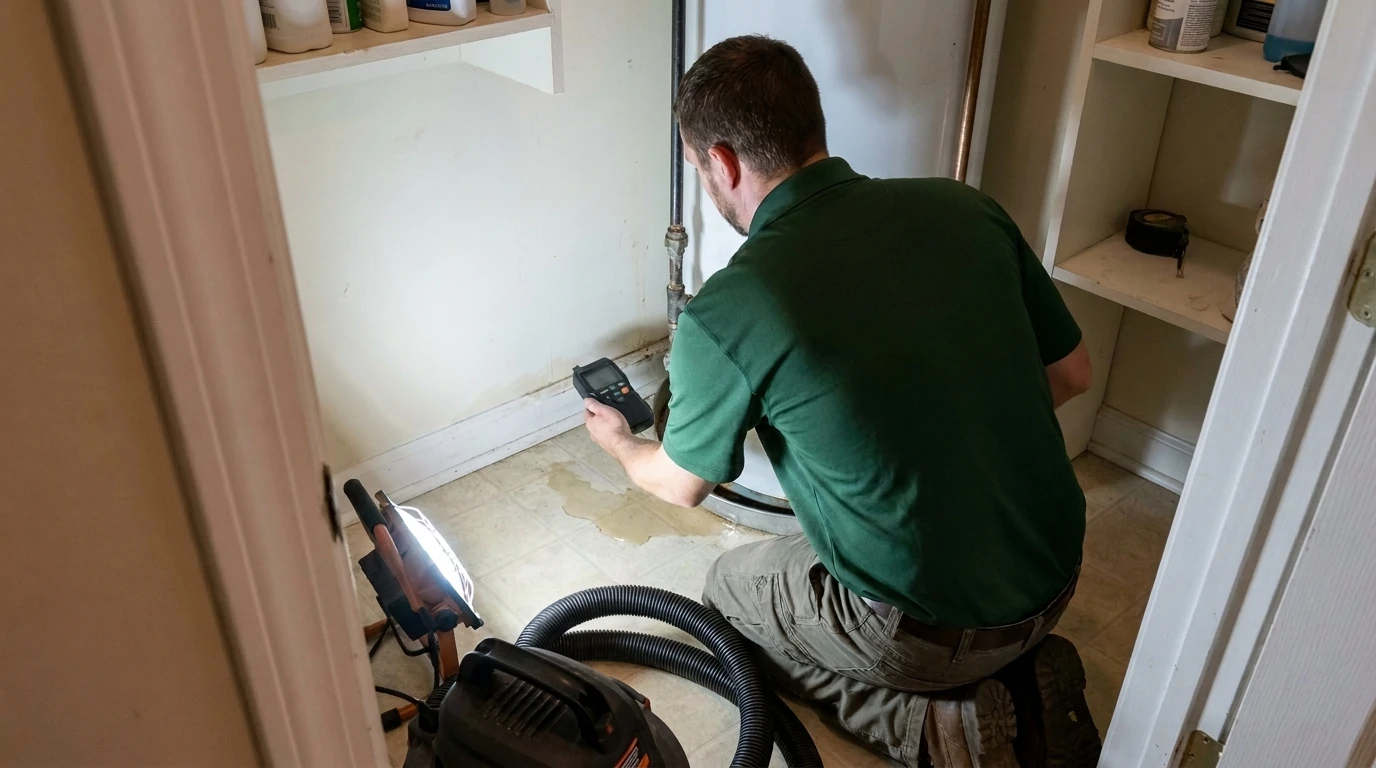
For a leaking water heater in Middlesex, NC, call Go Green Restoration of NC at (919) 906-5473 once water has reached the floor, the subfloor, or nearby drywall, any hour of the day, since Go Green answers that line 24/7. If the tank is still actively failing and the water hasn’t spread past the immediate area, call a plumber first to stop it at the source. Go Green handles what the water damaged on its way out, not the water heater itself.
Who do you call first, a plumber or a restoration company?
Call a plumber when the water heater itself needs repair or replacement. Call Go Green Restoration when the leak has already wet flooring, subfloor, drywall, or stored items. Most Middlesex calls need both, usually in that order.
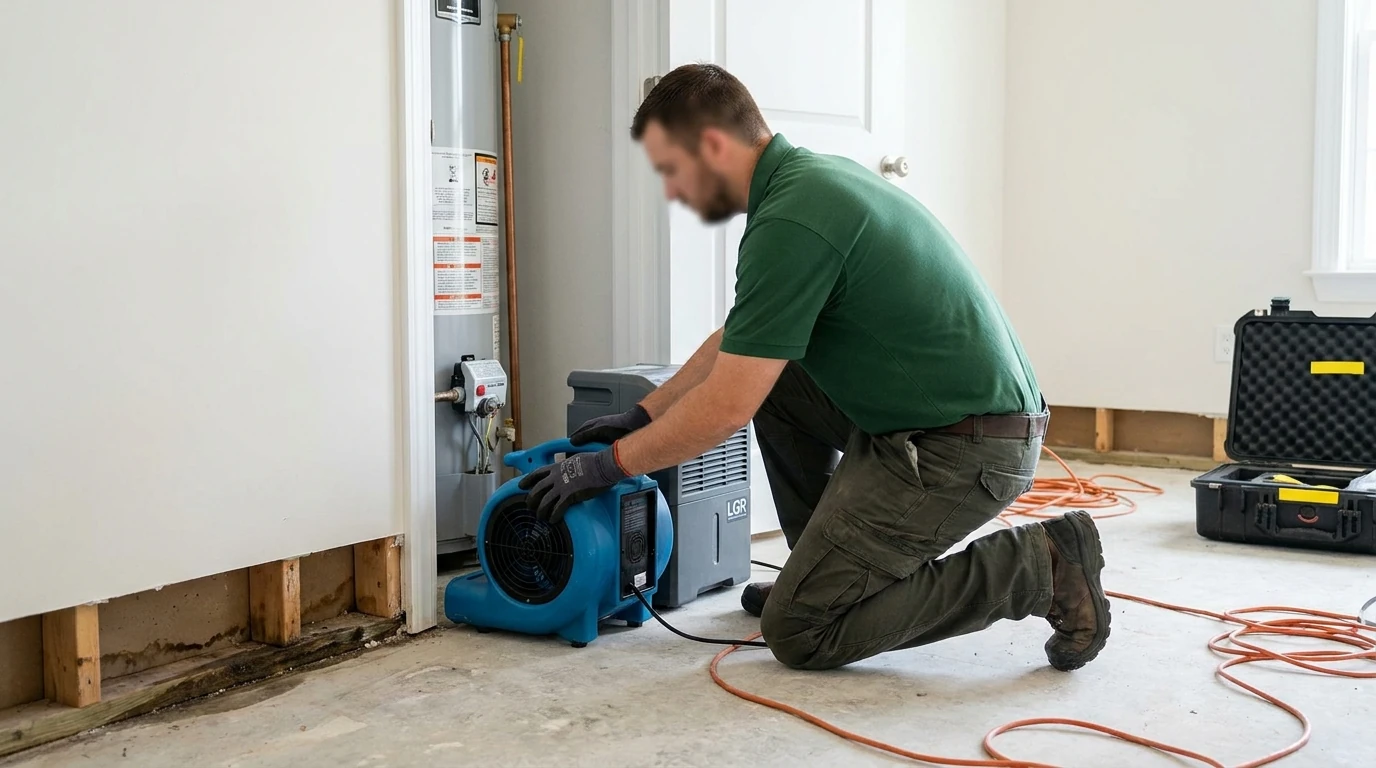
Water heaters sit in closets, garages, and crawl space access points across Downtown Middlesex and the US-264 corridor, which means a slow leak can soak into a shared hallway wall or a bedroom closet before anyone notices. Once water reaches wood subfloor or drywall, that part of the job belongs to a restoration crew, not a plumber, because drying it correctly takes moisture meters, air movers, and sometimes a dehumidifier running for several days.
If the tank is actively gushing, a supply line failed or the pressure relief valve stuck open, shut the cold water supply valve on top of the tank and cut power (or gas, for a gas-fired unit) before you call anyone. Standing water near an electrical panel or a gas appliance is a hazard, not a wait-and-see situation.
Is a leaking water heater an emergency?
A leaking water heater is an emergency when water is actively spreading across flooring, soaking drywall, or pooling near outlets or a crawl space access point. A damp drip pan with no active flow can usually wait for a scheduled plumber visit during business hours.
Water straight from a supply line starts out relatively clean, but it doesn’t stay that way once it sits against wood, insulation, or carpet pad. Restoration crews follow the S500 standard for exactly this reason: category and timeline both matter. In Nash and Johnston County’s humid stretches, trapped moisture under a water heater closet or a crawl space liner can start supporting mold growth within 24 to 48 hours, a window we’ve covered in detail. That clock is the real argument for calling sooner rather than later.
Does it matter if the leak is from the bottom, the top, or the drain valve?
Where the leak starts tells you which call to make first. A leak from the top usually means a failed inlet or outlet fitting, a plumber’s repair. A leak from the bottom almost always means the tank itself has corroded through, which means replacement, not a patch. A leak from the drain valve or the temperature-and-pressure overflow pipe can sometimes be tightened, but a steady drip there usually means that valve is already near the end of its life.
In every version of this, Go Green’s part of the job starts at the water that already got out: extracting standing water, pulling baseboard where it’s swollen, checking subfloor moisture with a meter, and drying the area. A water leak detection check is also worth asking about if this isn’t the first time water has shown up near the unit, since a slow leak that comes back is often a sign of a second source.
What happens when you call Go Green Restoration after a water heater leak?
A technician documents the moisture with a meter, extracts standing water, and sets containment and drying equipment, often the same day the call comes in.
When you call, have a few things ready: how long water has been visible, what it’s touched (hardwood, carpet, finished basement, crawl space), and whether the water supply and power are already shut off. On arrival, the crew checks moisture levels in the subfloor, baseboards, and adjacent walls, removes material that can’t be dried in place, like swollen baseboard or soaked carpet pad, and positions air movers and a dehumidifier to bring the space back to a dry standard. If the leak drained into a crawl space, the crew also checks under the vapor barrier, since crawl spaces in this part of Nash and Johnston County hold humidity longer than a finished room would. Go Green also photographs and logs the damage, which matters if you end up filing a claim; our plain-English guide to what homeowners insurance covers walks through how that typically plays out.
A water heater leak rarely stays contained to the closet it started in once it reaches wood framing or insulation. If yours has already reached flooring, drywall, or a finished space, schedule a water heater flood cleanup assessment or contact Go Green Restoration and have a plumber handle the tank in parallel. Call Go Green Restoration of NC at (919) 906-5473 any time, day or night.